Czech Media Funding Reform Draws Mass Protest, Raising Investor Risks
A proposed shift to state-budget funding for public broadcasters has triggered a major protest and heightened concern over Czech governance.
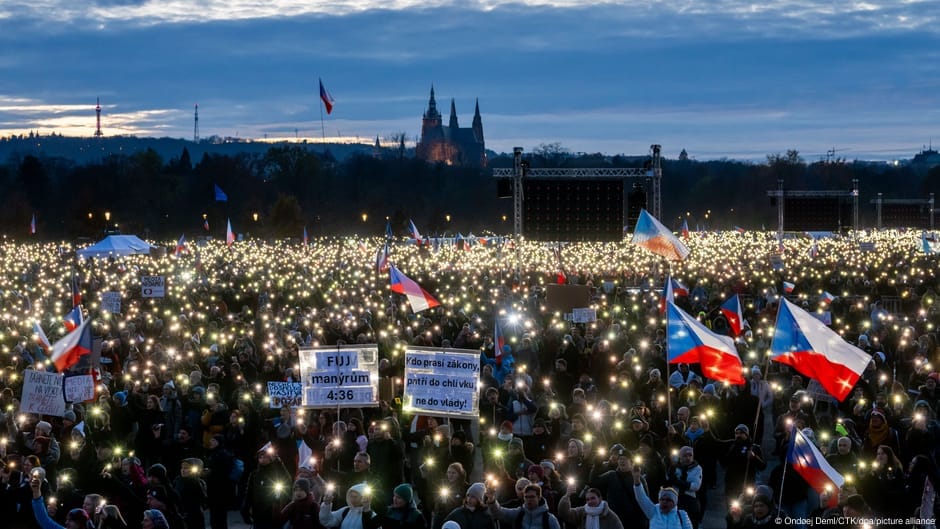
Hundreds of thousands of people demonstrated in Prague on Sunday, November 15, against government plans to overhaul the financing of the Czech Republic’s public-service media, creating a fresh political risk for investors monitoring the country’s equities and sovereign debt.
Organizers estimated that roughly 400,000 people attended the anti-government rally, potentially making it one of the country’s largest protests since the Velvet Revolution. The immediate dispute concerns broadcasting finance, but the scale of the turnout raises broader questions about institutional stability, coalition discipline and the government’s ability to advance contested legislation.
The proposed reform would abolish household subscription fees for public radio and television and replace them with direct funding from the state budget. Critics argue that dependence on annual government allocations could threaten both the independence and the continued operation of the broadcasters.
“An elected government has the right to govern the country. But it does not have the right to do whatever it wants and dismantle democratic institutions,” said Mikuláš Minář, chairman of the Milion Chvilek initiative that organized the protest.
For capital markets, the confrontation adds a governance dimension to the Czech investment outlook. The source material cited no immediate moves in Czech stocks or bonds, but investors typically watch large demonstrations and abrupt legislative initiatives for signs of policy disruption. The relevant questions now are whether the government withdraws the bill, amends it with stronger independence safeguards or pushes ahead despite public opposition.
Accelerated Vote Draws Institutional Scrutiny
Activists, civil-society organizations and the Czech opposition have also criticized the way governing parties promoted legislation that could directly affect public broadcasters. The bill was introduced for its first reading outside the planned parliamentary schedule on Friday, October 23, with a vote set for the same night—an approach described as highly unusual in Czech political practice.
The Prague demonstration, held at Letná, was named “Letná Against 4:36,” referring to the time scheduled for the vote. The procedural dispute could matter to investors because it broadens the issue beyond the cost of broadcasting and into the predictability and transparency of policymaking.
The governing coalition consists of right-wing and populist parties and leads a government headed by billionaire Andrej Babiš. Coalition representatives, including the anti-immigration Freedom and Direct Democracy party, or SPD, have previously criticized media coverage of their activities.
Opposition politicians have compared the proposed changes with the process through which Hungarian authorities brought public-service media under government control during Viktor Orbán’s rule. Protesters are demanding that the authorities either withdraw the legislation or involve experts who could develop substantive guarantees protecting broadcasters from political influence.
Funding Cut Sharpens Fiscal Trade-Off
Czech public-service media are currently financed through monthly household fees totaling 205 koruna, equivalent to about €8.50. Babiš says the reform would fulfill an election promise to reduce the financial burden on citizens.
However, shifting broadcasters to state-budget financing would reduce the funding available to them by 15%. In nominal terms, television funding would return to its 2008 level, while radio funding would fall back to its 2005 level, even though operating costs have increased since then. Television and radio companies have called the proposal unacceptable.
The fiscal savings for households therefore come with a direct funding squeeze for the broadcasters. From an investor perspective, the immediate amounts are less significant than the precedent created by moving an established institution from dedicated fee income to politically determined budget allocations. That change could expose funding to annual fiscal negotiations and future shifts in government priorities.
The dispute had already disrupted operations before the Prague rally. In early November, Czech public-service media staged a strike and limited broadcasting in protest against the planned changes. Further industrial action or sustained demonstrations could keep political uncertainty elevated while lawmakers determine the bill’s future.
What Investors Are Watching
No specific reaction in Czech equities, government bonds or the currency was provided in the source report. The near-term market focus is therefore likely to remain on political developments: the size and duration of further protests, whether coalition parties remain united, and whether expert consultation produces enforceable protections for media independence.
For holders of Czech assets, the episode presents a test of institutional checks rather than an immediate corporate earnings event. A negotiated revision or withdrawal of the bill could reduce political tension. An uncompromising push to enact the measure, by contrast, could prolong protests and intensify scrutiny of Czech governance among international investors.
The government’s next move will determine whether the confrontation remains a sector-specific dispute over public broadcasting or develops into a wider challenge to its legislative agenda. With an estimated 400,000 people mobilized in the capital, markets have reason to monitor the political response even in the absence of a documented price reaction.



