France Protests Draw 320,000 as Investors Weigh Political Risk
A third consecutive Saturday of nationwide demonstrations brought 565 arrests, though official turnout continued to decline.
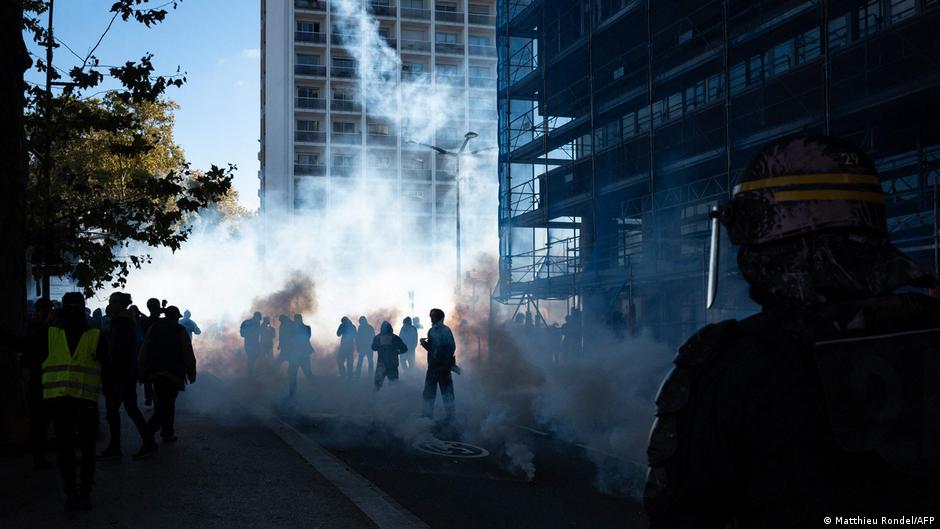
France faced a third consecutive Saturday of nationwide protests as 320,000 people took to the streets and police detained 565 participants, according to figures released by the Interior Ministry. For investors, the demonstrations add another source of political and social uncertainty in one of Europe’s largest economies, with the cost of living and strains in public education among the protesters’ central grievances.
The official turnout was lower than during the two previous Saturdays, suggesting that participation may be losing momentum even as confrontations remain a concern. Authorities estimated that 550,000 people demonstrated on October 17 and 410,000 on October 24. Organizers disputed the latest official count, saying nearly 500,000 people joined Saturday’s protests.
About 70,000 demonstrators gathered in Paris, according to the authorities. Interior Minister Laurent Nuñez said the protests were largely peaceful but accused members of far-left groups of using “monstrous violence” against law enforcement officers.
Social Unrest Adds to France’s Risk Picture
The demonstrations have direct relevance for capital markets because they center partly on the rising cost of living, an issue closely connected with household confidence, consumer spending and the broader outlook for the French economy. The protests do not, by themselves, establish a clear direction for French equities or government bonds. They nevertheless create an additional political-risk factor for investors assessing the country’s fiscal choices, public-service pressures and capacity to contain prolonged unrest.
The decline in official turnout may provide some reassurance that the movement is not expanding at the pace recorded earlier in October. However, the scale of the security deployment and the continuation of violent clashes indicate that the disruption has not ended. France mobilized 70,000 police officers across the country to maintain order, a substantial nationwide operation.
Official participation fell from 550,000 on October 17 to 410,000 on October 24 and 320,000 on October 31.
In Paris, five police officers were injured during clashes with several hundred protesters. Authorities said three were struck by Molotov cocktails. One officer’s clothing caught fire, and he was diagnosed with a burn to his leg. Demonstrators also threw paving stones and rocks at police, who responded with tear gas and batons.
Clashes were reported beyond the capital. In Toulouse, police deployed water cannon and tear gas against participants in an unauthorized demonstration. An unauthorized march involving about 10,000 people took place in Marseille and later developed into confrontations with police. Officers also used tear gas during unrest in Lyon, according to France24.
Education Protests Broaden Into Economic Discontent
The nationwide movement began in late September with protests by school pupils and university students. Initial complaints included teacher shortages, overcrowded classrooms, excessively long school days, outdated school buildings and a lack of modern equipment. Participants also voiced anxiety about their future, including difficulties gaining admission to universities.
The protests subsequently attracted people dissatisfied with a broader range of social problems, including the cost of living. Demonstrations also became more likely to end in disorder, with burning rubbish containers and vehicles, vandalism, looting and severe confrontations with police.
The widening of the movement matters to investors because it links pressure on public services with household economic concerns. If such grievances persist, markets may focus more closely on whether the government faces demands for additional spending or other policy responses. The source figures do not quantify any fiscal impact, and no specific measures were announced in connection with Saturday’s events. The immediate signal is therefore one of elevated uncertainty rather than a measurable change in France’s financial position.
The unrest has also acquired a wider European dimension. Demonstrations in France inspired young people to organize protests in Italy, Germany and Belgium. Protests in major German cities ended in disorder on October 31, underscoring the possibility that youth-led dissatisfaction could become a broader regional issue rather than remain confined to France.
What Investors Are Watching
For equity investors, the main considerations are the duration and geographical spread of the disruption, as well as any effect on consumer activity and business operations. Bond investors are likely to monitor whether political pressure translates into new public spending commitments or complicates the government’s policy agenda. Neither outcome can be inferred from the available protest data alone.
The contrasting turnout estimates also warrant caution. The government’s count of 320,000 is well below the organizers’ estimate of almost 500,000, leaving disagreement over the movement’s current scale. Even under the higher estimate, however, organizers did not report a figure exceeding the official estimate of 550,000 participants on October 17.
Saturday’s events present markets with a mixed picture: participation is declining according to official estimates, but arrests, injuries and clashes remain widespread. Investors will now look for evidence of whether the movement continues to lose momentum or develops into a more durable challenge driven by education concerns, living costs and dissatisfaction with public services.



