Poland’s Independence March Highlights Political Risk for Investors
President Karol Nawrocki joined the Warsaw rally as Poland’s government and presidential camp remained locked in an institutional dispute.
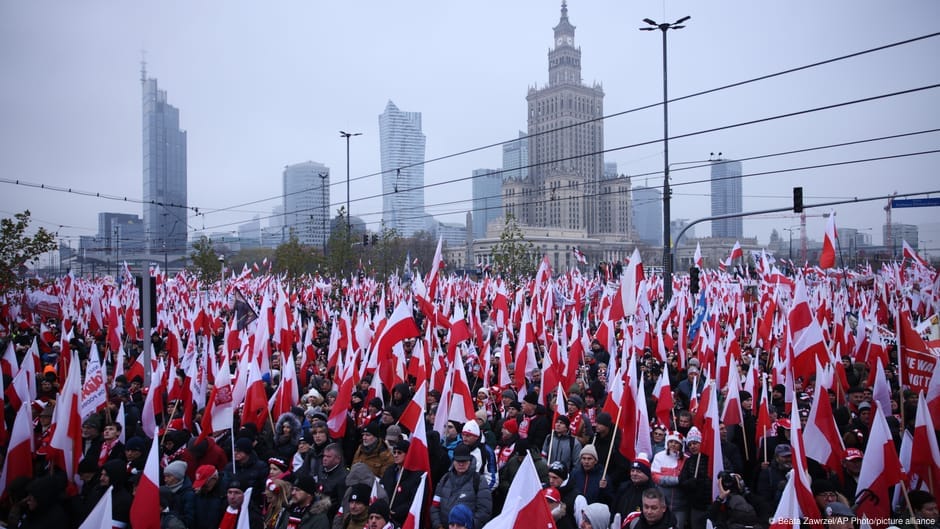
WARSAW — Polish President Karol Nawrocki joined a large Independence Day march in Warsaw on Wednesday, November 11, placing the country’s deep political divisions in renewed focus for investors assessing institutional stability in one of Central Europe’s largest capital markets.
Warsaw city authorities estimated that about 250,000 people attended the so-called Independence March, an annual event initiated by nationalist and far-right groups. Organizers put attendance at more than half a million. The disparity between the estimates could not be independently reconciled from the information provided.
The demonstration took place only days after a shooting in central Krakow that killed six people, according to AFP, and amid a struggle between Prime Minister Donald Tusk’s government and Nawrocki’s camp for control of the Constitutional Tribunal. Security was tightened for the event.
For equity and bond investors, the march itself offers no direct signal on corporate earnings or public finances. Its significance lies instead in the political backdrop: a high-profile confrontation over a central state institution, combined with a major street mobilization attended by the president. Prolonged institutional conflict can influence perceptions of policy predictability, the legislative environment and the broader governance risks attached to Polish assets.
Institutional dispute enters the investor spotlight
Nawrocki was photographed carrying the Polish flag during the march. He called for a “strong and effective state” and criticized “elites acting against the will of the people,” AFP reported. His participation associated the presidency with an event organized by political forces to the right of Poland’s mainstream governing camp.
Tusk declined to attend. Instead, the prime minister appealed for national unity, saying:
“On November 11, all hearts are white and red.”
The contrasting approaches underscored the rivalry between the government and the presidential camp. Investors commonly follow such divisions for evidence of whether they could delay legislation, complicate appointments or weaken the consistency of economic policymaking. The source material provided no figures showing a reaction in Polish equities, government bonds or the currency, so the immediate market impact cannot be quantified.
Any investment implications therefore remain tied to future developments rather than a documented trading move on the day. Market participants are likely to focus on whether the Constitutional Tribunal dispute escalates, whether it affects the implementation of government policy and whether political tensions begin to alter fiscal or regulatory expectations.
Large turnout under heightened security
The event began with Poland’s national anthem. Some participants carried torches, whose thick smoke enveloped sections of the procession, according to AFP. Many wore red and white clothing and waved national flags.
Near the Palace of Culture and Science, tents and stalls formed what journalists described as an “independence city.” Rosaries, prayer books, red-and-white wreaths, hot tea and sauerkraut were distributed there. The area also featured antisemitic and anti-Ukrainian books, as well as items bearing far-right symbols.
AFP correspondents observed banners carrying slogans including “Make Europe white again,” “Poland is not for sale” and “Remigration, deportation.” The first echoed the structure of US President Donald Trump’s “Make America Great Again” slogan.
Far-right groups have organized similar demonstrations in Poland every year since 2011. Organizers present the event as a commemoration of Poland’s restoration of independence on November 11, 1918, after 123 years of foreign rule by Russia, Prussia and Austria.
From a capital-markets perspective, the scale of the gathering illustrates the strength of political currents that could shape future debates over migration, Poland’s relations with Ukraine and the direction of domestic institutions. Those issues may matter to companies exposed to labor availability, cross-border commerce, public procurement and regulatory decisions, although the source article did not identify any specific listed company or sector as directly affected.
The key question for holders of Polish equities and sovereign debt is whether the visible polarization remains largely symbolic or develops into sustained institutional disruption. For now, the march adds political-risk context rather than measurable evidence of a repricing in financial markets.



