Polish Tribunal Crisis Deepens Political Risk for Capital Markets
A contested leadership suspension at Poland’s Constitutional Tribunal has triggered protests and intensified a clash between government and president.
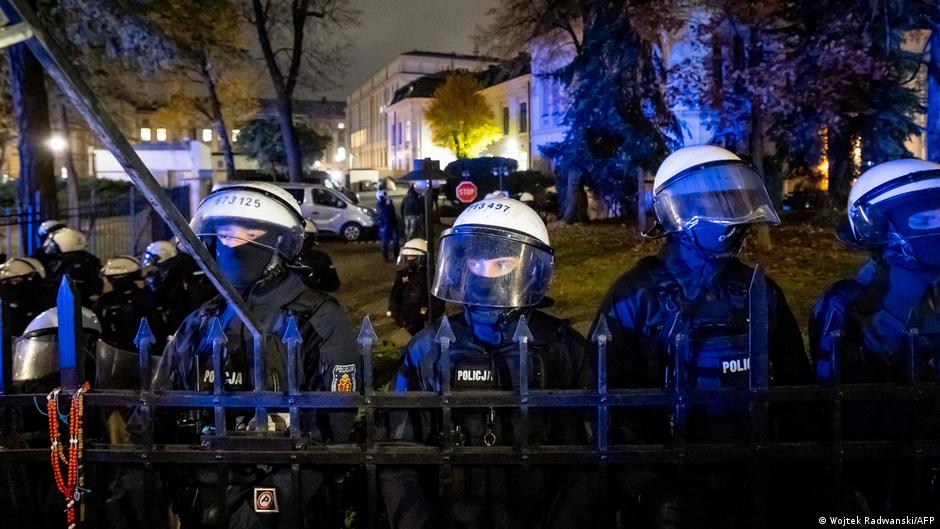
Poland’s constitutional crisis escalated sharply on Friday, adding a fresh layer of political and institutional risk for investors exposed to the country’s equities, government bonds and currency. Police cordoned off the Constitutional Tribunal in Warsaw as demonstrators gathered outside, while President Karol Nawrocki abandoned a planned trip to Senegal and returned to Poland.
The confrontation began after Anna Korwin-Piotrowska, described as one of the tribunal’s 15 judges, announced the one-month suspension of tribunal president Bogdan Święczkowski and vice-president Bartłomiej Sochański. Her decision was published on the tribunal’s website on the evening of October 30.
The document said the two officials had, among other things, obstructed judges appointed by the Sejm in 2026 and already sworn in from participating in cases. Korwin-Piotrowska based her authority on a 2016 law governing the tribunal’s organization and procedures, which she said allows the longest-serving judge to take such action. She also called a general meeting of tribunal judges for November 3.
Competing Claims Raise Institutional-Risk Premium
A message published through the institution’s account on X alleged an “illegal seizure” of the tribunal’s website and said Święczkowski and Sochański remained in their positions. It also asserted that Korwin-Piotrowska was not a Constitutional Tribunal judge and accused those involved of committing the crime of a coup. The tribunal’s website, in turn, said the X account was not associated with the institution.
The contradictory statements leave investors facing uncertainty over who controls one of Poland’s central constitutional bodies. No specific market-price reaction was detailed in the source material, but the dispute has direct relevance for the risk premium attached to Polish assets: prolonged uncertainty over judicial authority can complicate policy implementation, deepen conflict between branches of government and weaken confidence in institutional predictability.
“I have no idea what is going on. Ms. Anna Korwin-Piotrowska called me and said that she now runs the tribunal. I know nothing more,” Sochański told Rzeczpospolita.
Sochański called the development unprecedented and said he was unaware of any complaints against him or any legal provision allowing his suspension. He described the intervention as an attack on the tribunal’s independence and also characterized it as a coup.
Prime Minister Donald Tusk supported the temporary removal of the tribunal’s leadership. Tusk and the Sejm are politically opposed to Nawrocki, who is associated with the Law and Justice party, or PiS. Tusk said restoring the rule of law was the government’s duty after years of what he called lawlessness under PiS, describing the process as difficult, sometimes painful and requiring decisive action.
Presidential Return Signals Further Escalation
Nawrocki said he turned his aircraft around while traveling to Senegal because of the events surrounding the tribunal. After returning, he met Święczkowski and Supreme Court First President Zbigniew Kapiński, then entered the tribunal building with Kapiński, according to presidential chief of staff Paweł Szefernaker.
The president entered despite Korwin-Piotrowska saying she was prepared to meet him only at the Presidential Palace. Maciej Berek, a tribunal judge elected by the Sejm but not admitted to take the oath by Nawrocki, accused the president of choosing “physical confrontation” with Korwin-Piotrowska. Berek also said people identifying themselves as presidential-office employees had tried to obtain keys to rooms in the tribunal.
Warsaw police said Prosecutor General and Justice Minister Waldemar Żurek asked officers to pay particular attention to security during protests around the building. Police also received a letter from one tribunal judge warning of a potential threat to life and health. Officers cordoned off the site but said they were not inside the building.
Police reported that protesters threw dangerous objects at officers. Three demonstrators were detained after climbing over a barrier and entering the tribunal grounds.
What Investors Are Watching
The confrontation has been developing for several months and centers on the struggle between Tusk’s government and Nawrocki’s PiS camp. It began when the president refused to accept the oaths of new judges elected by the current parliament. Święczkowski likewise declined to recognize their authority or allow them to hear cases.
The government considers the tribunal illegitimate because it still includes judges elected under the previous authorities. The governing coalition and judges supporting its position regard Nawrocki’s actions as unlawful obstruction of the institution’s work.
The immediate capital-markets issue is whether the dispute remains contained within legal and political institutions or expands into a longer confrontation involving public disorder and policy paralysis. Investors in Polish government bonds will be alert to any erosion in institutional confidence, while equity investors will assess whether the conflict delays legislation, regulatory decisions or fiscal measures. Currency markets may also become more sensitive to signs that the confrontation is affecting governance.
Legal pressure on the existing tribunal leadership is also increasing. On October 30, Żurek said he had filed five applications with the Constitutional Tribunal seeking the lifting of immunity. He said the requests included cases concerning Święczkowski and Sochański. The November 3 judges’ meeting and any further action on those immunity applications are likely to provide the next tests of whether Poland can resolve the dispute without a broader institutional rupture.



