Russian Drone Strike on Kharkiv Homes Highlights Investor War Risks
The overnight attack injured four people and underscored the persistent security risks facing businesses, assets and investors in Ukraine.
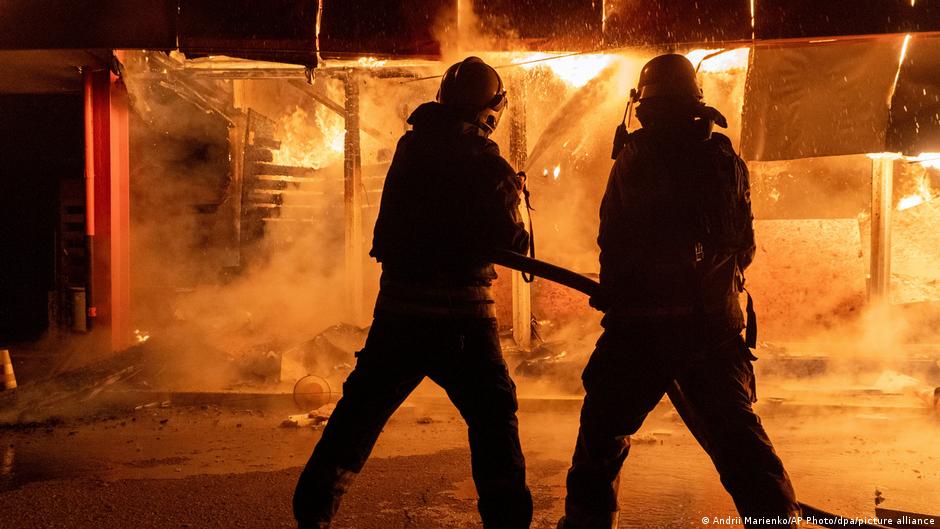
A Russian drone struck residential property in Kharkiv overnight on Wednesday, October 28, injuring four people, including a four-year-old boy, according to regional authorities. The attack also caused a fire at a two-storey industrial building, bringing renewed attention to the physical risks facing homes, commercial facilities and investment assets in Ukraine.
Oleh Syniehubov, head of the Kharkiv Regional Military Administration, said the attack affected the city’s Osnovianskyi district. A two-storey industrial building, a two-storey apartment block and a single-storey house caught fire following the strike, he reported on Telegram.
Syniehubov later identified the injured as two women aged 32 and 65, a 56-year-old man and the four-year-old boy. Three of the four required hospital treatment.
“A strike on an apartment building. According to the available information, people are trapped inside,” Kharkiv Mayor Ihor Terekhov wrote.
The reported impact on both residential and industrial property illustrates the overlapping humanitarian and economic consequences of continued attacks. For investors assessing Ukrainian exposure, damage to production sites and surrounding housing can affect operations simultaneously, disrupting facilities while also placing employees and local communities at risk.
Security Risk Remains Central to Asset Valuations
The latest strike did not come with reported figures for financial losses, production interruptions or damage to specific listed companies. Authorities also did not provide an estimate for repair costs. The immediate market significance therefore lies less in a measurable corporate earnings impact than in the persistence of the broader risk premium attached to Ukrainian assets and businesses operating near frequently targeted areas.
Equity investors typically assess such incidents through their potential effect on physical assets, workforce availability, transport links and operating continuity. Bond investors, meanwhile, remain focused on the wider fiscal and reconstruction burden created by repeated damage to residential and industrial infrastructure. The source reports did not describe any immediate reaction in equities, bonds or currencies following the Kharkiv attack.
Without confirmed links to publicly traded companies or critical financial infrastructure, the incident alone does not establish a direct valuation effect. It nevertheless adds to the security backdrop against which investors judge companies with Ukrainian facilities, suppliers or customers. Each new episode can reinforce uncertainty around insurance, capital spending, maintenance and the timing of reconstruction, even when the direct monetary cost has not yet been calculated.
Threat Warnings Extended Beyond Kharkiv
Ukraine’s Air Force separately warned of a possible ballistic weapons threat from Russia’s Bryansk region toward Kyiv. That warning was later withdrawn. According to messages published on the Air Force’s Telegram channel, however, attacks involving jet-powered unmanned aerial vehicles and guided aerial bombs continued toward the Kharkiv and Dnipropetrovsk regions, as well as Kyiv and the surrounding region.
The geographic spread of those warnings matters for capital markets because it indicates that security concerns are not confined to a single city or type of asset. Kharkiv is the location of the reported casualties and fires, while the alerts covering Dnipropetrovsk and the Kyiv area point to a wider operating environment in which risks can shift rapidly across regions.
For investors today, the practical consideration is whether companies and borrowers have sufficient liquidity, operational redundancy and contingency plans to withstand further disruption. No details on those safeguards were provided in connection with the affected Kharkiv properties, and there was no official information identifying the industrial building’s owner or its activities.
The absence of a disclosed damage estimate also limits any attempt to quantify the strike’s implications for corporate balance sheets or public finances. The confirmed facts remain that four people were injured, three required hospitalization, residential buildings were hit or caught fire, and a two-storey production facility also burned during the attack.
Markets may require clearer evidence of damage to major infrastructure, export capacity or named companies before repricing individual securities in response to this incident. Even so, the attack highlights why geopolitical and physical-security risks remain integral to evaluations of Ukrainian equities, sovereign and corporate debt, reconstruction-linked investments and businesses with operations in exposed regions.



