Slovak Protests Put Political Stability on Investors’ Risk Radar
Mass demonstrations against Prime Minister Robert Fico highlight political uncertainty as his coalition operates without an absolute majority.
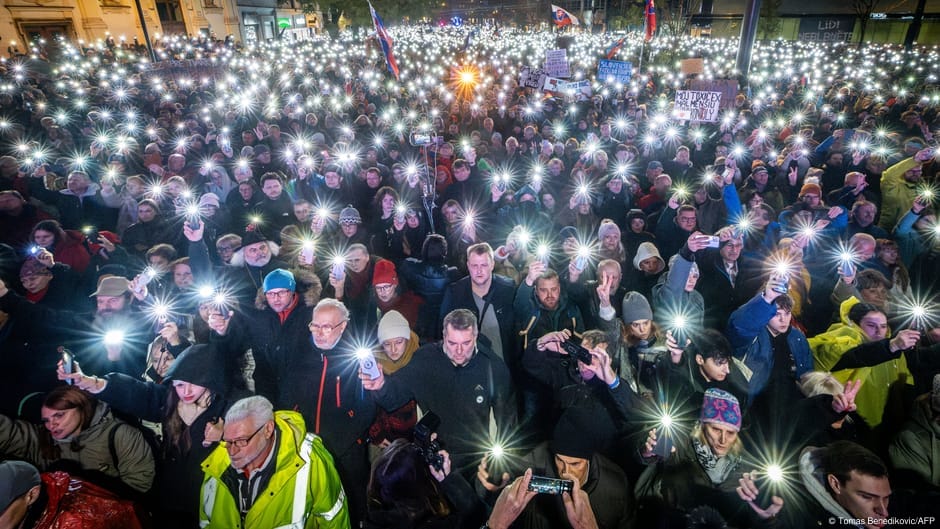
Thousands of people took to the streets across Slovakia to protest against Prime Minister Robert Fico’s government, its ties with the Kremlin, its approach to media control, alleged violations of LGBT rights and concerns over the rule of law.
The demonstrations, held on Monday, November 17, coincided with the 37th anniversary of the start of the 1989 Velvet Revolution in Czechoslovakia. The largest gathering took place in Bratislava’s Slovak National Uprising Square, where approximately 25,000 people participated, according to Progressive Slovakia, the country’s largest opposition party and the organizer of the event.
For investors, the protests add another visible sign of political strain in Slovakia at a time when Fico’s three-party governing coalition has already lost its absolute majority in parliament following the departure of several lawmakers. The opposition is demanding an early parliamentary election, although it does not have enough votes to approve one.
Political uncertainty enters the investment calculus
The demonstrations do not, by themselves, establish a direct market impact. The source material provides no evidence of a specific reaction in Slovak equities, government bonds or the euro. However, investors typically monitor large protests and fragile parliamentary arithmetic because they may affect the predictability of policymaking, the passage of legislation and confidence in public institutions.
The immediate issue for capital markets is therefore less the size of a single rally than the combination of sustained public opposition and a government that no longer commands an absolute parliamentary majority. A weakened coalition can face greater difficulty advancing policy, while pressure for an early election can shorten investors’ planning horizon and increase uncertainty over future priorities.
That uncertainty may be relevant to holders of Slovak government debt and companies with significant exposure to the country. Bond investors tend to focus on whether political fragmentation could complicate fiscal decisions or delay legislation. Equity investors, meanwhile, generally assess whether a less stable political environment could alter regulation, business confidence or investment plans. The protests offer no confirmed indication that any such changes have occurred, but they place those risks more firmly on the agenda.
Kremlin ties and institutional concerns draw scrutiny
Some demonstrators carried placards reading, “Russians, go home!” and “I don’t want a country I will have to flee.” Several participants told AFP they were dissatisfied with Slovak Foreign Minister Juraj Blanar’s recent visit to Moscow.
The crowd also chanted, “We’ve had enough of Fico!” and displayed banners calling for the resignation of the three-party government led by the prime minister.
“I don’t want a country I will have to flee.”
The criticism of the government’s Kremlin connections gives the protests a foreign-policy dimension alongside domestic concerns about media control, LGBT rights and the rule of law. For international investors, those issues can matter because perceptions of institutional quality and policy alignment influence assessments of political risk. Questions surrounding media independence and the rule of law may be especially relevant to investors evaluating regulatory transparency and the reliability of the operating environment.
At the same time, the available facts do not indicate an imminent change of government. Although the governing coalition has lost its absolute majority, the opposition lacks the parliamentary votes required to force an early election. That creates the possibility of continued political tension without a rapid institutional resolution.
What investors should watch next
The principal indicators for markets will be whether the protest movement persists, whether additional lawmakers withdraw support from the coalition and whether the opposition can build enough parliamentary backing to advance its demand for an early vote. Investors will also be watching for any disruption to the government’s legislative agenda or evidence that political divisions are affecting policy execution.
For now, the demonstrations represent a political-risk signal rather than a documented market shock. There is no reported evidence in the source of a selloff in Slovak assets, a change in bond yields or a reaction among listed companies. Nevertheless, the scale of the Bratislava rally and the coalition’s loss of its absolute majority may encourage investors to apply closer scrutiny to Slovakia’s political outlook.
The anniversary of the Velvet Revolution also gives the protests broader symbolic weight. Demonstrators linked their opposition to Fico’s government with concerns about the rule of law and the country’s political direction. For capital markets, the key question is whether that public pressure remains confined to street demonstrations or begins to reshape parliamentary support, government policy and the timing of Slovakia’s next election.



