Crimea Bridge Damage Raises Fresh Infrastructure Risk for Investors
Zelensky said the strategic link is a lawful Ukrainian target as extensive damage leaves repair costs and timelines deeply uncertain.
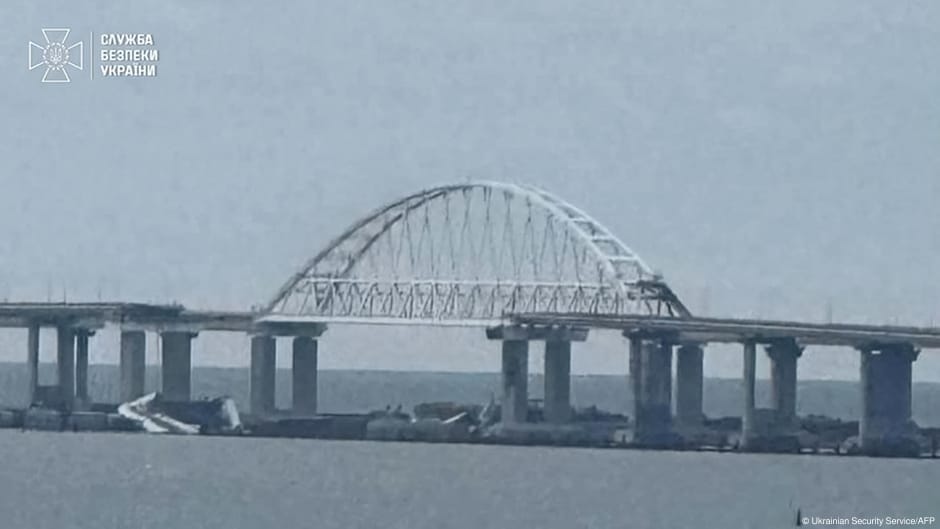
Ukrainian President Volodymyr Zelensky has warned that the Crimea Bridge will not survive, reinforcing the prospect of further attacks on a strategic Russian transport link already facing extensive damage and an uncertain reconstruction timetable.
For investors assessing exposure to the war, the statement adds to infrastructure, logistics and fiscal risks surrounding Russian-controlled Crimea. The bridge carries road and rail traffic across the Kerch Strait and, according to Zelensky, is used by Russia to transfer as many weapons as possible to the peninsula. Ukrainian military reports also frequently identify annexed Crimea as a launch area for missiles and unmanned aerial vehicles.
In an interview with NBC News on Friday evening, November 20, Zelensky said Russian President Vladimir Putin must understand that the bridge “will not survive.” He argued that attacks on the structure are lawful because Russian forces have occupied Crimea since the spring of 2014.
“This is our entirely legitimate target, because they occupied Crimea — our Crimea,” Zelensky said.
He said Russia had first occupied Ukrainian territory, then built the bridge and declared it part of Russia. Moscow subsequently changed its constitution and domestic legislation in an attempt to formalize control over Ukrainian territories, Zelensky said, adding that those steps have no international recognition and were not supported by the rest of the world.
Repair uncertainty compounds logistical pressure
The warning comes after several reported strikes caused significant damage to both the road and railway sections of the bridge. On the morning of November 16, the Russian-installed authorities in Crimea reported an attack and restricted vehicle traffic. A day later, reports said one of the bridge’s arches and part of the roadway had collapsed into the sea after a repeat strike. The railway section was targeted during the night of November 19 and is now heavily damaged.
Russian Deputy Prime Minister Marat Khusnullin said on November 20 that Ukrainian strikes had damaged the main beam of an arched span as well as the arch itself. He said a possible repair schedule could not be established until engineering plans had been produced.
Russian authorities had announced the resumption of train services across the bridge one day earlier. Khusnullin said officials expected to assess the restoration timetable within a week. Some individual elements might be returned to service in one or two months, he said, while the outlook for the rest of the structure would depend on further inspection and the current storm season.
The lack of a firm timetable matters from a capital-markets perspective because prolonged disruption can increase transport costs, complicate military and civilian supply routes and create additional demands on public spending. The source material did not provide figures for reconstruction costs, market movements or the effect on specific Russian equities and bonds. Investors must therefore treat the immediate financial impact as uncertain rather than assume a quantified loss.
Estimates point to a potentially lengthy reconstruction
Andriy Koretsky, an associate professor specializing in bridges, tunnels and hydraulic structures at Kyiv’s National Transport University, estimated that restoration could take between 1.5 and three years. He said manufacturing the arch alone would require about a year, after which it would still need to be assembled at a site, transported and installed.
Koretsky also questioned whether Russia would be able to carry out another installation near Ukraine’s border without further disruption. His assessment differs sharply from the shorter initial intervals discussed by Russian officials for restarting selected bridge components, highlighting the wide range of possible outcomes facing infrastructure planners and investors.
Zelensky indicated that attacks on the bridge could continue. He said Russia must experience the consequences of war and recognize that it cannot retain control of the Ukrainian peninsula. After Russian attacks on Ukrainian facilities, Kyiv had been compelled to respond, including by striking the bridge, he said.
He added that Ukraine would not accept territories remaining under Russian occupation, whether the issue is ultimately resolved through diplomacy or military action. That position leaves the bridge exposed to continuing conflict risk even if limited transport operations resume.
For holders of Russian sovereign and corporate debt, as well as investors tracking transport, construction and commodity-linked companies, the central issue is not a confirmed market repricing but an increase in uncertainty. Repeated damage may require continuing repairs while limiting the bridge’s reliability as a logistics corridor. It also raises the possibility that spending must be committed to an asset that remains within range of further Ukrainian operations.
The immediate signals to monitor are the promised Russian engineering assessment, the durability of restored rail services and any additional restrictions on road traffic. Until those details emerge, estimates ranging from a few months for isolated components to as long as three years for broader restoration leave the economic burden and operational consequences unresolved.



