EU Plans New Ukraine Drone and Missile Funding as Markets Track War Risk
Brussels says Ukraine will be a central issue at this week’s European Council meeting, with investors watching defense, energy and bond-market implications.
The European Union is preparing to provide additional financing to Kyiv in mid-October for the purchase of drones and missiles, a move that keeps Ukraine’s defense needs high on the agenda for European policymakers and investors monitoring geopolitical risk across the region.
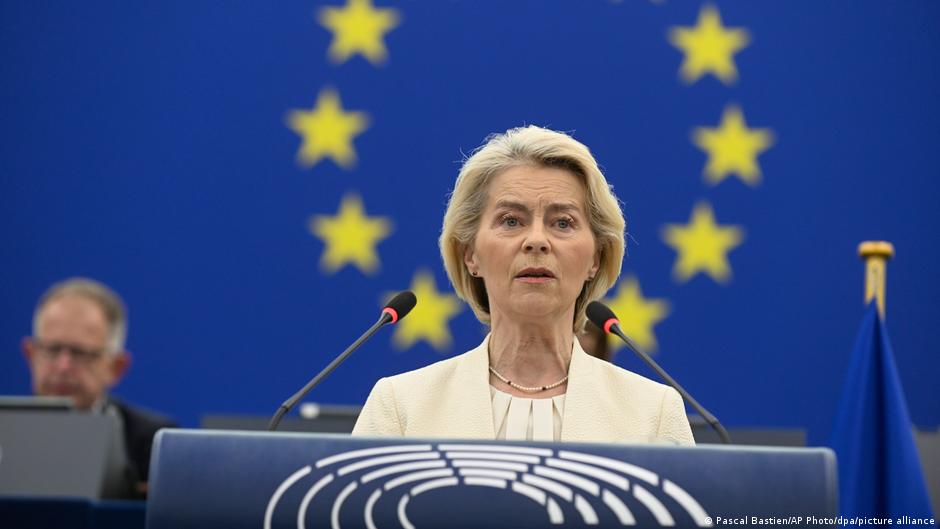
European Commission President Ursula von der Leyen wrote on X on Sunday, October 11, that the new support was needed to strengthen Ukraine’s defense and protect its airspace. She did not specify the size of the financing package or identify its funding sources, leaving markets without a precise figure to assess against existing EU budget commitments, sovereign borrowing plans or defense-sector expectations.
“This is necessary to strengthen Ukraine’s defense and protect its airspace,” von der Leyen said.
The announcement comes as Brussels prepares to put Ukraine among the central topics at this week’s European Council meeting. EU leaders are expected to discuss Ukraine’s financing needs for the coming year and ways to mobilize additional international support. For capital markets, the talks matter not only because they shape the flow of public funds to Ukraine, but also because they influence investor assumptions about European fiscal priorities, defense procurement, energy security and the duration of war-related risk premiums.
Investors Watch Funding Sources and Defense Demand
The absence of a disclosed amount or funding source is significant for investors. A defined envelope would allow markets to judge whether the new drone and missile financing is incremental, drawn from existing programs or tied to future EU-level borrowing and member-state contributions. Without that clarity, the immediate market read-through is qualitative: Brussels is signaling continued military and financial backing for Ukraine, while keeping the details for later political and budgetary negotiations.
Defense-related equities are likely to remain sensitive to such policy signals. Additional EU financing for drones and missiles reinforces the view that European governments are prioritizing air defense, long-range strike capabilities and battlefield technologies that have become central to the war. The source article does not identify any companies, contracts or procurement channels, but the policy direction is consistent with sustained public demand for defense equipment.
Bond investors, meanwhile, will be focused on whether future support is financed through existing EU instruments, national budgets or new mechanisms. The European Union has already built longer-term support for Ukraine through the Ukraine Facility, a program designed to provide stable and predictable financial assistance from 2024 through 2027. Brussels has said the facility can provide Ukraine with up to 50 billion euros over that period.
Earlier, on October 2, the European Commission approved a 2.9 billion euro tranche for Kyiv under the Ukraine Facility. Payments under the mechanism are closely linked to Ukraine’s implementation of a specific recovery and reform plan, as well as support for democratic mechanisms, the rule of law and human rights. Disbursements are made quarterly after checks that the conditions for receiving the funds have been met.
That conditional structure matters for markets because it frames Ukraine support as a recurring policy commitment rather than a one-off emergency payment. It also gives investors a calendar of potential disbursement points and reform milestones to monitor when assessing Ukraine-related sovereign risk, EU budget debates and the political durability of support.
Energy and Food Supply Risks Stay in Focus
Von der Leyen said she fully supported Ukrainian President Volodymyr Zelensky’s call for a ceasefire that would help protect global food supplies and energy infrastructure in Ukraine and Russia. That framing links the military and diplomatic discussion directly to market-sensitive assets, including agricultural commodities, energy prices and infrastructure-linked risk across the region.
For investors today, the market issue is not simply whether more European money reaches Kyiv. It is whether the conflict continues to threaten supply chains, power assets and export routes that feed into inflation expectations and central-bank policy assumptions. The European Commission president’s comments highlight the fact that food and energy remain central economic transmission channels of the war.
Von der Leyen also said the war had entered a new and even darker phase. According to the official, Russia is conducting a war of attrition on the battlefield and striking civilians far beyond the front line. Such language underscores why markets continue to attach a geopolitical premium to parts of Europe’s outlook, even when day-to-day trading is driven by earnings, rates and macroeconomic data.
The European Council meeting is also expected to address Ukraine’s path toward the European Union. Brussels indicated that two new clusters of topics will be unlocked as part of Ukraine’s EU negotiation process. While that is a political and institutional step rather than an immediate market catalyst, it is relevant for investors tracking Ukraine’s longer-term reform path, financing access and integration with European economic structures.
The near-term question for capital markets is whether EU leaders can translate the political signal into a clearly funded package. Equities tied to defense and security spending may respond to confirmation of procurement flows, while government bond markets will watch for signs of additional fiscal burden or EU-level financing. Energy and agricultural markets will remain alert to any developments that affect infrastructure security or export reliability.
For now, Brussels has delivered a clear policy message but not the financial mechanics. The EU intends to provide additional support for Ukrainian drones and missiles in mid-October, Ukraine will dominate part of this week’s European Council agenda, and the bloc’s longer-term Ukraine Facility remains the main structured channel for predictable financial assistance through 2027.