Georgia’s Pro-EU Rallies Put Political Risk Back in Investor Focus
Thousands rallied in Tbilisi as Georgia’s political direction renewed scrutiny of the country’s long-term investment outlook.
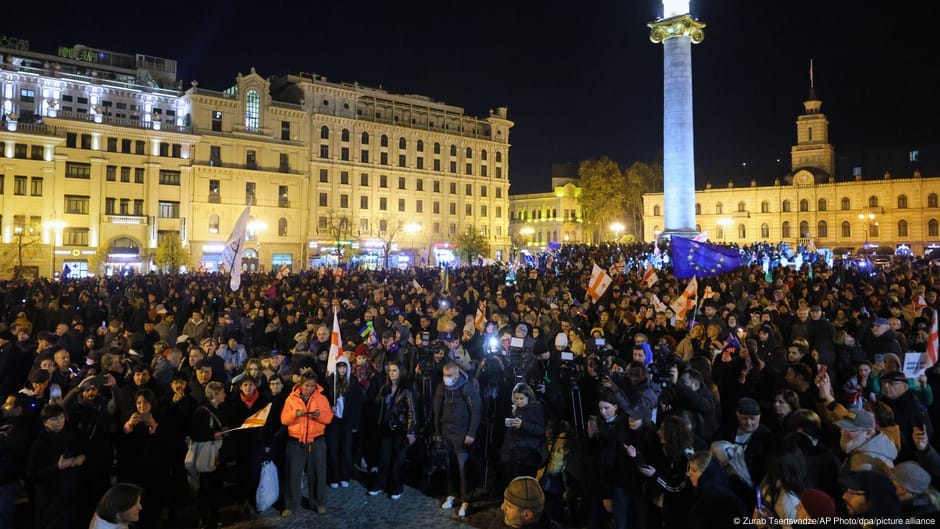
Pro-European demonstrations were held across several Georgian cities on Saturday, November 28, marking the second anniversary of the government’s decision to halt negotiations on joining the European Union.
Several thousand people attended the rally in Tbilisi, according to independent media reports. Detailed attendance figures for demonstrations in other cities were not available. In the capital, three marches that began in different districts converged on Freedom Square, where participants called for Georgia to return to a pro-European course.
The protests place the country’s political direction back in focus for investors assessing Georgian assets. Although the demonstrations did not produce an immediate change in government policy, the dispute touches on issues that can influence the long-term investment case: institutional stability, relations with the EU, the treatment of political opposition and the predictability of economic integration.
EU Path Remains Central to Political Risk
Demonstrators opposed the ruling Georgian Dream party, which critics describe as pro-Russian. Prime Minister Irakli Kobakhidze, a member of the party, announced in 2024 that accession talks with the EU would be frozen.
Former Georgian president Salome Zourabichvili was among the speakers addressing the Tbilisi rally. She said divisions had emerged among the country’s pro-Russian governing forces and argued that they were no longer acting as a unified group.
“It is only a matter of time before we come out and consolidate the victory,” Zourabichvili said.
For capital markets, the significance lies less in the immediate size of the rallies than in what they reveal about persistent political polarization. Investors in Georgian equities and bonds must weigh the government’s stated economic timetable against the possibility of prolonged domestic unrest, greater external pressure and further deterioration in relations with European institutions.
Georgia’s public markets are relatively limited, but political developments can still shape sentiment toward listed companies with Georgian exposure, sovereign and corporate debt, and financial institutions dependent on foreign capital. The latest rallies provide no direct evidence of a change in asset prices or borrowing costs. They do, however, reinforce the political uncertainty surrounding the country’s longer-term alignment.
Opposition Case Raises Institutional Concerns
Opposition representatives at the Tbilisi demonstration also criticized the government over what they described as the persecution of political opponents. Their objections center on a lawsuit brought by Georgian Dream seeking to have several opposition coalitions that participated in the 2024 parliamentary election declared unconstitutional.
The ruling party accuses the groups of denying the legitimacy of Georgian Dream’s government, attempting to use foreign pressure by urging other countries to impose sanctions on party members, and undermining confidence in elections. Georgian Dream has also criticized the coordination achieved by an opposition that has traditionally been fragmented.
If the targeted coalitions are ruled unconstitutional, their members would be prohibited from engaging in political activity. Such an outcome would affect most opposition parties, including For Georgia, the only opposition party represented in the current parliament.
That legal process is relevant to investors because constraints on political competition may intensify concerns about governance and institutional checks. Human rights advocates have repeatedly said that Georgia’s political environment has shown increasing signs of authoritarianism since accession talks were suspended, a trend at odds with the EU’s declared values.
Government Points to a Longer Economic Timeline
Kobakhidze announced on November 28, 2024, that negotiations on EU membership would be suspended for four years. Earlier that day, the European Parliament adopted a resolution refusing to recognize the results of Georgia’s parliamentary election, saying the outcome did not reflect the will of the Georgian people.
The prime minister argued that Georgia would be economically prepared by 2028 to begin accession negotiations in 2030. He also maintained that the authorities would continue moving toward the European Union.
For investors, those assurances compete with evidence of worsening political friction. A credible return to the EU track could support perceptions of regulatory convergence and institutional reform. Continued confrontation with European bodies, restrictions on opposition activity or renewed unrest could instead sustain a higher political-risk assessment.
The rallies therefore serve as a reminder that Georgia’s market outlook cannot be evaluated solely through economic readiness targets. The course of the opposition lawsuit, the durability of public protests and the government’s relations with Brussels are likely to remain important signals for holders of Georgian debt and equity exposure.