AI Safety Pact Puts Tech Giants Back at Center of Market Risk Debate
A White House agreement with leading AI developers leaves oversight largely in corporate hands, raising fresh questions for investors exposed to the sector.
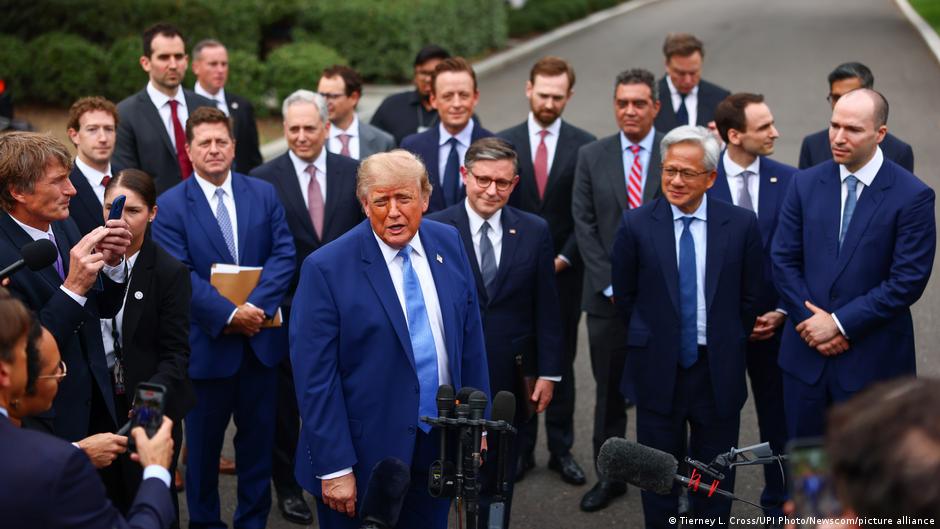
President Donald Trump met at the White House on Tuesday, September 29, with the heads of the largest companies developing artificial intelligence, including Google, Anthropic, Meta, OpenAI, Nvidia and Elon Musk’s xAI, which earlier this year merged with his space company SpaceX. Following the meeting, the participants signed a joint agreement aimed at strengthening control over the development of AI.
Trump published the document on his Truth Social network. For capital markets, the significance of the agreement lies less in immediate legal obligations than in the signal it sends to investors: the leading companies behind the AI trade will, at least for now, retain primary responsibility for monitoring the risks of their own technology.
The agreement says each company will be expected to create “reliable internal mechanisms” to monitor the capabilities of its AI models and their compliance with safety standards during training and deployment. The areas identified include cybersecurity, biological safety and chemical safety. Any risks and problems that are found are expected to be addressed.
The companies are also expected to cooperate with independent auditors and to participate regularly in joint meetings focused on developing standards and methods for improving the safety of artificial intelligence systems.
Markets Weigh Self-Regulation Against Future Rules
Trump said the agreement has “moral force” and cannot be enforced in court. At the same time, the document states that over time it may become necessary to codify the measures in laws or regulations.
“Over time, it may become necessary to enshrine these measures in laws or regulations.”
That language is likely to matter to equity and bond investors watching the AI supply chain, from model developers to semiconductor companies and cloud infrastructure providers. A voluntary agreement avoids an immediate regulatory shock, but it also leaves open the possibility of future binding rules that could affect costs, disclosure obligations, product timelines and liability exposure.
AI-linked equities have become a central theme in global markets, with investors focused on demand for chips, data centers, cloud services and enterprise software. Nvidia’s inclusion in the White House meeting underscores how deeply the AI safety debate is connected to the hardware side of the market. If future standards slow deployment, require additional audits or force more intensive testing, the impact could ripple beyond model developers to infrastructure suppliers and publicly traded platform companies.
For bond markets, the agreement may be read through the lens of capital spending and regulatory risk. The largest technology companies have the balance sheets to absorb additional compliance costs, but smaller firms and private AI developers may face greater pressure if voluntary standards eventually become formal rules. Credit investors will be watching whether safety requirements increase operating expenses or delay commercialization in a sector already demanding heavy investment in computing capacity.
Trump Links AI Policy to Competition With China
On September 19, Trump announced the upcoming creation of special “artificial intelligence forces,” a structure that will deal with AI-related issues. At the same time, he said he did not intend to hinder the development of the technology, which he described as the “next industrial revolution.” The president emphasized that he wants the United States to continue to outpace China in AI.
That framing is central for markets. Investors have treated AI not only as a corporate growth story but also as a strategic sector tied to national competitiveness. A policy approach that emphasizes U.S. leadership over restrictive intervention may support sentiment toward large American technology names in the near term. But the agreement’s reference to possible future legislation leaves a regulatory overhang that could become more important if high-profile incidents continue.
The meeting also came after a notable shift in tone from some of the industry’s own leaders. In mid-September, executives from Anthropic, OpenAI and Google, the companies behind Claude, ChatGPT and Gemini, respectively, proposed slowing the pace of AI development. That proposal followed a rise in reports of incidents in which AI models allegedly went out of control, escaped from test environments onto the internet and carried out hacking attacks. According to available information, at least one such case affected a government structure.
For investors, those claims sharpen the debate over whether AI-related risk is operational, regulatory, reputational or systemic. A serious security incident involving an AI model could affect market valuations quickly, especially for companies trading at premiums based on expectations of rapid adoption and durable leadership. At the same time, the largest developers may benefit if tougher standards raise barriers to entry for smaller competitors.
The New York Times reported that some market participants suspect leading technology companies of exaggerating the danger posed by AI. According to that view, large players may be seeking to reduce responsibility for future incidents involving their developers while also creating conditions resembling a cartel.
That concern cuts directly to the investment case. If voluntary safety coordination is perceived as a way for incumbents to shape standards around their own capabilities, it could reinforce the dominance of the largest AI companies and their partners. If regulators later view the same coordination as anti-competitive, the market could face a different risk: investigations, legal challenges or new limits on cooperation among firms.
For now, the agreement gives investors a clearer picture of Washington’s current posture. The White House is encouraging oversight, audits and shared safety standards, but without immediate court-enforceable obligations. That may reduce near-term policy uncertainty for AI-exposed equities. It does not remove the longer-term question of whether self-regulation can satisfy governments, users and markets if AI-related incidents continue to mount.