German Draft Refusal Filings Surge as Defense Labor Needs Test Markets
A sharp rise in conscientious objection filings highlights the fiscal and labor-market pressures behind Germany’s military expansion plans.
Germany’s effort to rebuild military capacity is moving from a defense-policy debate into an issue with direct implications for investors watching public spending, labor supply and political risk in Europe’s largest economy.
From January through the end of August 2026, at least 12,102 people in Germany declared that they did not want to serve in the country’s armed forces, according to figures reported by the Funke media group on Monday, October 5. The filings were submitted to the Federal Office for Family and Civil Society Affairs, known as BAFzA.
The increase is striking when set against the previous year. In all of 2025, German authorities received 3,879 applications from people seeking to refuse military service. That means the number of objectors in just the first eight months of 2026 was more than three times the total for the whole of last year.
For capital markets, the data point is not only social or political. It goes to the execution risk around Germany’s defense build-up: whether Berlin can expand the Bundeswehr largely through voluntary recruitment, or whether it may need to move closer to a compulsory model that could affect labor availability, household sentiment and the political backdrop for fiscal policy.
Recruitment Reform Meets Investor Scrutiny
The sharp rise in refusal filings is partly linked to the Federal Defense Ministry’s decision to begin sending questionnaires to young people. A reform of Bundeswehr recruitment took effect on January 1. Under the law, from 2026 onward, 18-year-old men are required to complete a questionnaire asking whether they are willing to join Germany’s armed forces. Young people also have the right to declare in advance that they refuse military service.
Compulsory service in Germany has been suspended since 2011. It could, however, be partially reintroduced by a decision of the Bundestag. The planned mechanism, described as military service in case of necessity, is intended to be used if Germany fails to reach the required number of volunteers.
That target is substantial. According to plans by the German Defense Ministry, as many as 260,000 people should be serving in the Bundeswehr at the same time by 2035. Investors assessing German defense contractors, government bond supply and broader fiscal priorities will be watching whether that personnel objective can be met without stronger forms of compulsion.
Germany’s recruitment drive is becoming a test of how quickly a major European economy can expand defense capacity without triggering wider social and labor-market resistance.
BAFzA has also signaled that not every application is immediately valid. A representative of the office said objectors often make mistakes when completing their filings. The content of some applications does not meet the requirements for recognizing the refusal as justified, and such applications therefore have to be returned without consideration, according to the official quoted by media.
That administrative bottleneck matters because headline objection numbers may overstate the number of recognized claims. Still, the surge in filings is a clear indicator of rising resistance among some young Germans as military recruitment becomes more visible.
Defense Stocks, Bonds and the Cost of Manpower
The market angle is twofold. First, Germany’s defense sector has been supported by expectations of higher procurement spending and a broader European security reset. A recruitment shortfall would not necessarily weaken that spending impulse; in some cases, it could reinforce demand for technology, equipment and systems that reduce manpower needs. But it could also raise questions about whether personnel constraints will slow the operational impact of higher defense budgets.
Second, the public-finance implications are significant. A Bundeswehr scaled toward 260,000 personnel by 2035 would require sustained funding not only for weapons and infrastructure, but also for salaries, training, administration and long-term military readiness. For bond investors, the question is how Germany balances defense ambitions with other budgetary pressures while preserving confidence in its fiscal framework.
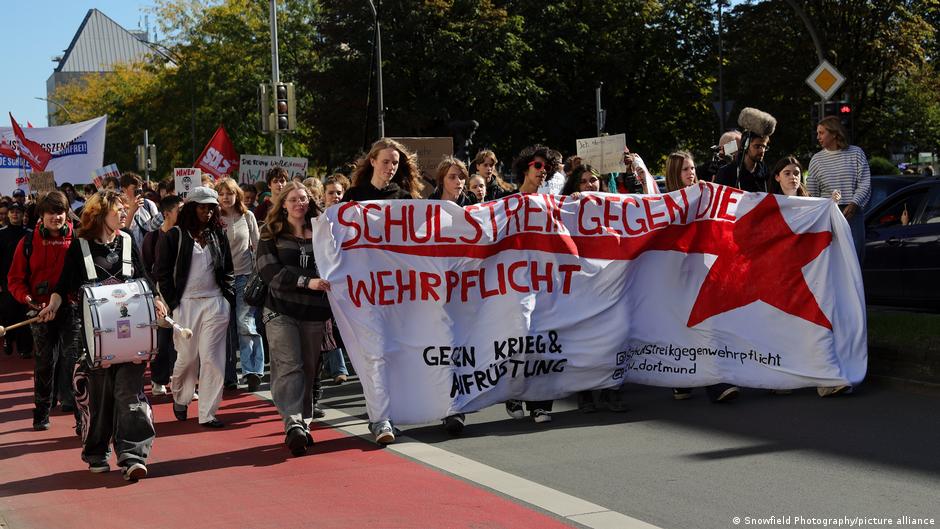
The Bundeswehr has broadened its search for recruits in recent years. Its outreach has included a stand at Gamescom, one of the world’s largest video-game trade fairs, held in Cologne. At the same time, German school students have criticized the possible return of military service in case of necessity. In September, large protests on the issue took place in a number of German cities.
Those protests underline a political risk that investors cannot entirely discount. Defense spending enjoys strategic momentum across Europe, but the domestic politics of recruitment are more sensitive than procurement contracts or budget lines. Any move toward partial compulsory service could become a flashpoint, particularly among younger voters and families.
Bundeswehr Numbers Are Still Rising
The objection data do not mean Germany’s recruitment effort has failed. At the end of July 2026, the German Defense Ministry reported that the Bundeswehr had reached its highest personnel level in 13 years, with 186,700 service members. Compared with July 2025, that represented an increase of more than 2%, or 3,700 personnel.
The ministry also said that of roughly 378,000 people who had been sent questionnaires since the start of 2026, about 2,630 went through the service-suitability assessment process in July alone. That was 35% more than in the previous month.
By that point, around 12,100 volunteers and short-term contract service members were already serving in the Bundeswehr under the new recruitment system. That figure was about 6% higher than a year earlier.
The ministry also recorded a significant increase in applications and admissions for contract military service. In July 2026, 47,300 people submitted corresponding applications, up 26% from the same month a year earlier. As of the end of July, the number of new recruits stood at 15,400, a 12% increase compared with 2025.
For investors, the mixed picture is important. Germany is attracting more recruits and contract-service applicants, while at the same time recording a sharp increase in refusal filings. That combination suggests the defense labor market is expanding, but so is resistance to participation.
In the near term, the issue is unlikely to move markets on its own. But it feeds into larger questions already shaping European asset allocation: the durability of defense spending, the labor-market effects of rearmament, the political limits of military expansion and the fiscal cost of meeting long-term security goals. For German equities tied to defense and for bond investors tracking budget commitments, recruitment data are becoming another indicator to watch.