Bosnia Vote Extends Dodik Allies’ Grip as Investors Watch Political Risk
Preliminary results showed governing-party candidates prevailing across Bosnia and Herzegovina, reinforcing continuity in a politically fragile market.
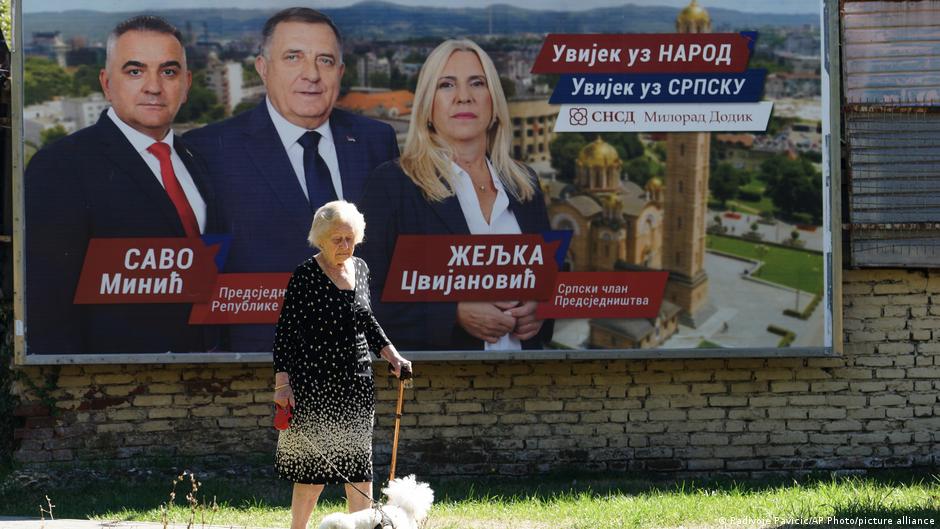
Preliminary election results in Bosnia and Herzegovina pointed to a broad victory for candidates backed by ruling parties, including allies of Milorad Dodik, the former president of Republika Srpska known for his close ties to Russia. For investors, the outcome offers political continuity but does little to remove the institutional and geopolitical risks that have long shadowed the country’s capital-market profile.
Savo Minic, the prime minister of Republika Srpska, won the presidential election in the Serb-majority region, according to preliminary results. Minic was supported by Dodik, whose influence remains central to the region’s politics despite a court decision barring him from political activity for six years. Zeljka Cvijanovic, another Dodik ally, was also on track to remain in Bosnia and Herzegovina’s tripartite presidency as the Serb member.
The vote covered members of the state presidency, the central parliament, two regional parliaments and the presidency of Republika Srpska. Based on preliminary results released by the Central Election Commission on Sunday evening, October 4, the elections produced no major surprises: candidates from ruling parties prevailed.
Continuity May Calm Markets, But Structural Risk Remains
From a capital markets perspective, the immediate signal is one of continuity rather than rupture. Investors in frontier and emerging European assets often price political surprises quickly, especially in small markets where liquidity is limited and institutional risk can affect sovereign borrowing costs, local equities and bank exposure. In this case, the preliminary results suggest that the main power structures in Bosnia and Herzegovina, and especially in Republika Srpska, remain largely intact.
After 95% of ballots were counted, Denis Becirovic remained the leading candidate to represent Bosniak Muslims in the national presidency. Becirovic had previously served as chairman of the presidency and had received about 38% of the vote. The Croat seat was expected to go to Darijan Filipovic, who had about 48% of the vote. Serb voters gave their support to Cvijanovic, who had about 55% and had also previously served in the presidency.
Bosnia and Herzegovina has a distinctive presidential system in which the duties of head of state are exercised jointly by three presidency members representing Croats, Bosniak Muslims and Serbs. The arrangement stems from the 1995 Dayton Accords, which were designed to settle disputes among Bosniak Muslims, Orthodox Serbs and Catholic Croats and ended the civil war. Many analysts regard the resulting system as inefficient.
For investors, Bosnia’s election result is less a reset than a reminder: the country’s markets remain tied to a complex constitutional structure and persistent regional political tensions.
The central question for markets is whether political continuity in Republika Srpska reduces near-term uncertainty or entrenches the same governance frictions that have weighed on the country’s investment case. Bosnia and Herzegovina is not a large equity market, but political stability still matters for banks, infrastructure financing, sovereign spreads, public-sector investment and the confidence of foreign investors weighing exposure to the Western Balkans.
Republika Srpska Vote Was the Main Market Watchpoint
The most closely watched contest was the election for president of Republika Srpska, an entity within Bosnia and Herzegovina populated predominantly by Serbs. The race featured opposition candidate Branko Blanusa against Prime Minister Savo Minic. Preliminary results showed Minic winning, with leads in most electoral districts across Republika Srpska. Blanusa carried some districts, but according to Central Election Commission data, those gains did not alter the overall result.
Minic and Cvijanovic both ran under the banner of the Alliance of Independent Social Democrats, or SNSD, the party founded by Dodik. The SNSD was also winning the election for the Republika Srpska parliament, the National Assembly, according to the Central Election Commission. Most Bosnian Serbs also voted for the same party in elections to the lower chamber of the national parliament, the House of Representatives of the Parliamentary Assembly.
That concentration of support gives the SNSD a reinforced mandate in Republika Srpska and a strong position among Bosnian Serb representatives at the state level. For investors, that may lower the probability of abrupt policy shifts in the near term. At the same time, Dodik’s continued role, despite legal restrictions, keeps political risk elevated. In 2025, he was forcibly removed from office for failing to comply with decisions of Bosnia and Herzegovina’s Constitutional Court and international agreements.
Dodik has refused to recognize the court decision and traveled to Moscow seeking support. He and Minic met Russian President Vladimir Putin in the Kremlin on September 29. Those ties are likely to remain a focus for international observers and investors monitoring geopolitical risk in the Western Balkans, especially at a time when capital flows into emerging Europe remain sensitive to sanctions risk, rule-of-law concerns and relations with Western institutions.
Dodik has already congratulated both Minic and Cvijanovic on their victories. Although he is barred by court order from political activity for six years, the election results underline that his political network remains durable. That durability may offer predictability to domestic constituencies but could also sustain tensions with state institutions and international actors.
For bond investors, the key issue now is whether the election outcome leads to a period of administrative stability or further confrontation over Bosnia and Herzegovina’s constitutional order. For equity investors and banks with regional exposure, the vote reinforces the need to distinguish between political continuity and genuine risk reduction. The preliminary results may avoid the shock of a contested shift in power, but they leave unresolved the deeper questions that shape Bosnia’s investment outlook: institutional efficiency, fiscal coordination, geopolitical alignment and the durability of the Dayton-era political framework.