Italy Cost-of-Living Protests Keep Political Risk in Focus for Investors
Demonstrations across major Italian cities highlight economic pressures that could influence sentiment toward equities and sovereign bonds.
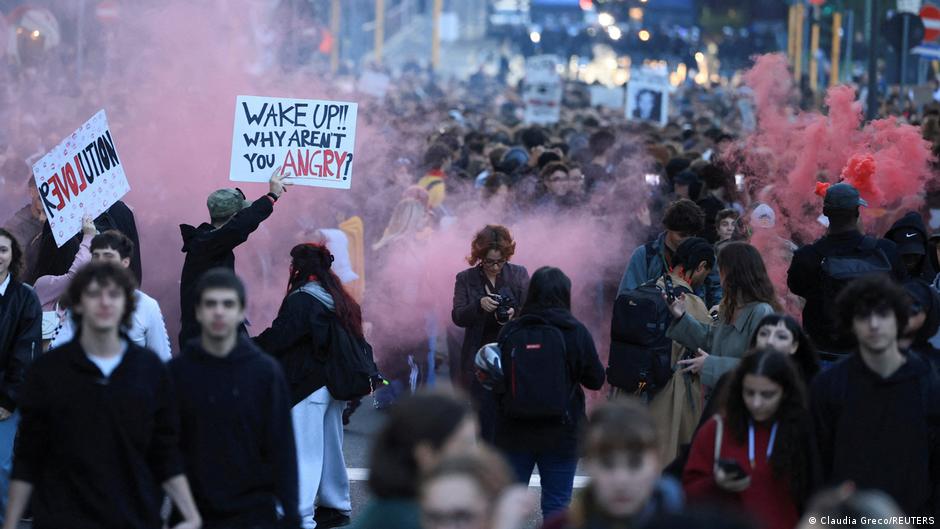
Protests over Italy’s high cost of living continued on Saturday, October 24, keeping domestic political and economic risks in view for investors assessing the outlook for Italian assets. Demonstrators also opposed rising fuel prices, increased armaments spending and the policies of Prime Minister Giorgia Meloni’s government.
Police reported nine arrests and 371 preliminary detentions, including 110 involving minors. The latest demonstrations followed protests on October 17 and 18 that descended into unrest, prompting the Italian authorities to reinforce security measures.
For capital markets, the demonstrations underline persistent pressure on household finances and the political sensitivity of inflation, energy costs and public spending priorities. Those issues can affect investor confidence in consumer-facing companies, the government’s fiscal room for maneuver and perceptions of risk surrounding Italian sovereign debt.
Security tightened after earlier unrest
Italian authorities deployed 500 members of elite military units to Milan after the earlier protests. The government also simplified procedures for detaining minors and for imposing financial penalties on their parents when property is damaged.
Drones and helicopters were used to monitor the demonstrations, while patrols at railway stations were reinforced. Authorities also closely tracked online activity to identify new calls for unrest.
The scale of the security operation may matter to markets less through its immediate cost than through what it signals about the government’s assessment of the situation. A prolonged cycle of demonstrations could sharpen scrutiny of policy responses to living costs, fuel prices and defense expenditure, particularly if unrest disrupts transport, retail activity or tourism in Italy’s largest cities.
The protests place household purchasing power, energy costs and government spending choices at the center of Italy’s political-risk outlook.
Milan retailers protect luxury storefronts
In Milan, the protests remained largely peaceful until the evening, according to dpa. Demonstrators nevertheless clashed with law enforcement in the city center, where police stopped a column of protesters and used batons.
Fearing renewed unrest, the owners of many luxury stores barricaded their windows. That precaution carries particular significance in Milan, a major center for high-end retail and fashion. Although the source reported no financial estimates or company-specific damage, visible defensive measures around luxury shops illustrate the potential exposure of premium retail districts to disruption and weaker foot traffic.
Investors in consumer and luxury equities may therefore watch whether the demonstrations remain episodic or begin to affect commercial activity. The underlying grievance over living costs is also relevant to the broader consumer sector: pressure from fuel and other prices can constrain discretionary spending even when protests themselves cause only limited disruption.
Demonstrations spread across major cities
In Bologna, police used tear gas and water cannon to prevent a column of demonstrators from approaching the railway station. In Turin, law-enforcement officers pushed protesters back with shields.
Rome saw a predominantly pro-Palestinian demonstration pass through the historic center. At one point, participants entered the Colosseum, dpa reported. Protest actions also took place in Naples and Florence.
The geographic spread of the demonstrations increases their relevance for investors because it shows that the discontent was not confined to a single city. Milan, Rome, Turin, Bologna, Naples and Florence are important centers for commerce, transport, industry and tourism. Any sustained disruption across several urban areas could influence near-term business conditions, although the source provided no evidence of broad economic damage or a direct market reaction.
Bond and equity investors assess policy implications
Italian government bonds are sensitive to perceptions of fiscal credibility, political stability and the wider interest-rate environment. The protests do not by themselves establish a change in Italy’s credit outlook, but they highlight competing demands facing the government. Measures intended to ease household pressure could require public resources, while higher armaments spending is itself among the issues opposed by demonstrators.
Equity investors face a more sector-specific calculation. Retailers and consumer businesses may be exposed to weaker purchasing power, while transport and tourism operators could be vulnerable if demonstrations interfere with stations or historic city centers. Luxury businesses in Milan face the additional operational risk illustrated by stores barricading their windows.
For investors today, the immediate focus is likely to be on whether unrest persists, whether security measures prevent further disorder and whether the government adjusts its economic agenda. Any escalation that affects commerce or forces new fiscal commitments could increase attention on Italian equities and bonds. Conversely, a return to peaceful demonstrations with limited disruption would reduce the likelihood of a lasting market impact.