Yabloko Clears Novgorod Threshold, Preserving a Route Into Duma Races
The liberal party’s showing offers limited political continuity for investors monitoring Russia’s tightly managed electoral landscape.
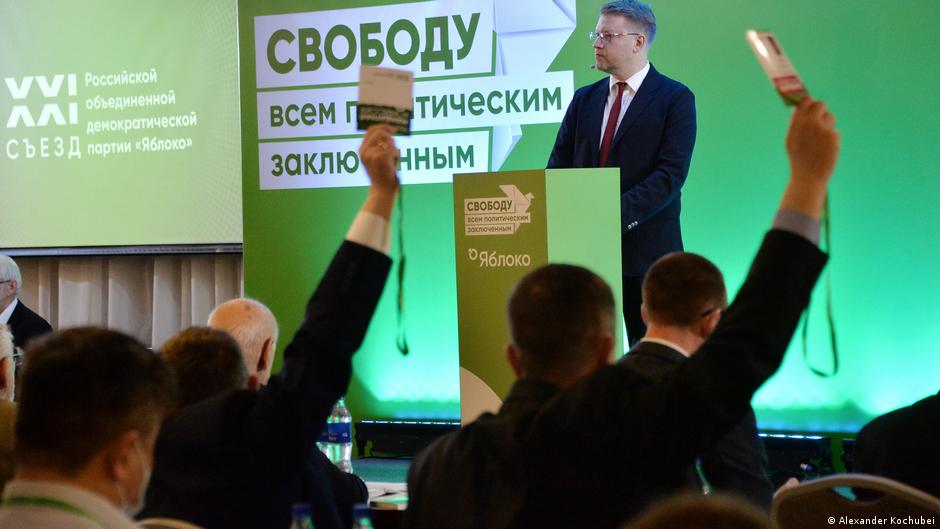
Russia’s liberal Yabloko party is on course to enter the Novgorod regional legislature after winning 6.2% of the vote with 96.86% of protocols counted, according to the Russian Central Election Commission. The result clears the 5% threshold for representation in the Novgorod Regional Duma and gives the party a practical benefit beyond the region: it will be able to continue taking part in State Duma elections without collecting signatures.
For investors, the result is not a market-moving event in the conventional sense. Russian equities, local bonds and currency pricing are driven far more directly by interest rates, fiscal policy, capital controls, sanctions, commodity flows and the war in Ukraine than by regional parliamentary arithmetic. Still, the outcome matters as a signal within Russia’s political risk framework, because it preserves a narrow institutional channel for a party that has been identified as the only Russian party to oppose the war in Ukraine.
Yabloko’s 6.2% result also marks a rise from the previous election at the same level in 2021, when the party received 3.83% of the vote. The improvement comes despite what a party source described as a campaign conducted under highly difficult conditions, including the removal of its list leader and the marking of its entire ballot list with a label referring to a “foreign agent” affiliation.
Managed politics, limited market relief
The Novgorod result does not alter the broad market thesis around Russia: policy remains highly centralized, investability is constrained for many foreign institutions, and political risk continues to be priced through sanctions exposure and access to capital rather than through competitive electoral turnover. The ruling United Russia party remained in first place in the Novgorod vote, with 38.37%, according to the reported figures. The Communist Party was at 14.54%, the Liberal Democratic Party at 12.01%, New People at 9.87%, A Just Russia at 7.7%, and the Party of Pensioners at 5.55%.
That distribution points to continuity rather than a structural change in Russia’s political economy. For equity investors with exposure to Russian-linked assets, the immediate implication is that the institutional status quo remains intact. Regional representation for Yabloko does not imply a shift in fiscal priorities, corporate governance practice, foreign policy, or sanctions risk. But the party’s ability to maintain formal eligibility for future national contests without gathering signatures may be relevant to longer-horizon assessments of political pluralism and the durability of opposition channels inside Russia’s electoral system.
The practical importance of regional representation was emphasized by a Yabloko source who spoke anonymously to DW. The source said the Novgorod result had clear operational significance for the party because having a deputy in a regional parliament allows Yabloko to keep participating in State Duma elections without collecting signatures. Before these elections, the party had three factions in Pskov, St. Petersburg and Karelia, but the source said the lists there had been removed.
“For Novgorod, of course, we are very pleased with the preliminary result,” the source said, adding that the presence of a regional deputy had practical significance for future State Duma participation.
The same source said the campaign in Novgorod took place in extremely difficult conditions. The entire list on the ballot was marked with a label about a “foreign agent” because the list leader, party deputy chair Anna Cherepanova, had been recognized as affiliated with a “foreign agent.” The source also said Cherepanova herself was removed from the election because of an administrative case under Article 20.3 of Russia’s Code of Administrative Offenses. Even so, the source argued, neither the labeling nor the removal of the list leader prevented the party from showing a strong result.
Political risk remains the investor lens
The broader background is the party’s exclusion from the federal State Duma race. On August 10, Russia’s Supreme Court removed Yabloko’s federal list from the State Duma elections following a lawsuit by Rodina, which accused the party, among other things, of copyright violations and illegal payments for election campaigning. Candidates from Yabloko are nevertheless taking part in voting in single-mandate districts.
For markets, this reinforces a familiar divide between formal electoral participation and meaningful policy uncertainty. The continued presence of Yabloko in a regional legislature may reduce one procedural obstacle for the party, but it does not change the central drivers that investors are watching today. In Russian local-currency debt, the more immediate questions remain inflation, monetary policy, budget financing needs and the scale of state support for strategic sectors. In equities, the focus stays on dividend capacity, restrictions on foreign ownership and repatriation, sector-specific sanctions, and the profitability of companies tied to commodities, banking, infrastructure and defense-adjacent activity.
Still, political signals can matter at the margin when investors assess country risk. A system that allows a limited opposition presence may be interpreted differently from one that fully excludes it, even if the practical policy impact remains small. Yabloko’s result in Novgorod therefore adds a nuance rather than a new direction: the party has preserved a route into future Duma participation, while Russia’s overall political environment remains tightly constrained.
The source article also notes that among Russian parties, only Yabloko opposed the war in Ukraine. After the party was removed from the federal list, Vladimir Putin had “excluded from the electoral process the last significant voice of opposition,” Jürgen Hardt, the Christian Democratic Union and Christian Social Union parliamentary group’s foreign policy spokesman in the Bundestag, said in a comment to DW.
That assessment underscores why a small regional result can receive attention well beyond Novgorod. For international investors, the issue is not whether Yabloko’s 6.2% share changes asset prices on its own. It is whether the result provides evidence about the resilience of any remaining opposition infrastructure inside Russia, and how that fits into a broader risk premium already shaped by war, sanctions, legal unpredictability and state dominance over strategic economic decisions.