Georgia Protests Renew Political Risk Focus for Capital Markets
Opposition leaders plan a major November 28 rally as a court reviews a bid to ban parties, heightening investor scrutiny of Georgia.
Georgia’s opposition has declared the start of a new wave of protests against the policies of the ruling Georgian Dream party, renewing political-risk concerns for investors exposed to the country’s equities, bonds and currency-sensitive assets.
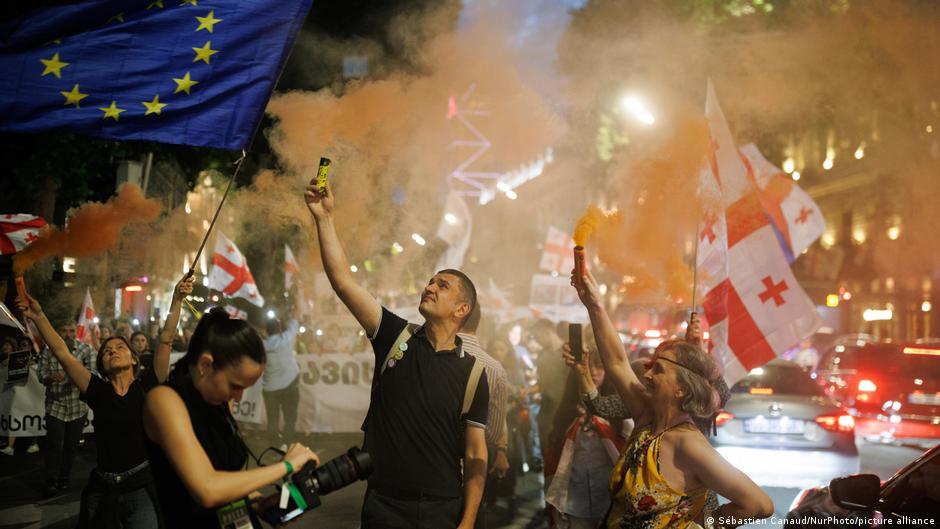
Thousands of people joined a march in Tbilisi on Sunday, October 25, according to Kavkazsky Uzel, as Georgia’s Constitutional Court considers a lawsuit seeking to ban opposition parties. Organizers from opposition groups and civil society held the demonstration under the slogan “Georgia Without Ivanishvili,” a reference to Georgian Dream founder Bidzina Ivanishvili.
Participants walked from Tbilisi State University toward Rustaveli Avenue, carrying the flags of Georgia, Ukraine and the European Union. A large security-force presence was also reported at the demonstration.
No specific movement in Georgian equities, sovereign bonds or other financial assets was reported in connection with Sunday’s march. Still, the prospect of sustained demonstrations adds another political variable for investors assessing Georgia’s risk premium, policy direction and ties with the European Union.
November 28 rally becomes the next focal point
Nika Gvaramia, leader of the Coalition for Change, described the march before it began as the opening of a new protest wave. Opposition leaders are seeking a larger mobilization on November 28, the second anniversary of the start of mass protests in Georgia, although Gvaramia said the culmination could also come in the days that follow.
“We are starting today, and we definitely need a culmination, whether it is November 28 or in the following days. It is important that there are very many of us on the 28th, so that the wind cannot extinguish the fire,” Gvaramia said, according to Kavkazsky Uzel.
For capital markets, the scale of the planned rally and the government’s response will be important indicators of whether political tensions remain contained or develop into a broader confrontation. Investors typically watch such episodes for possible effects on economic policymaking, institutional stability and relations with international partners. The reported security presence is also relevant because earlier Georgian demonstrations were marked by clashes and forceful police dispersals.
Gigi Tsereteli, leader of European Georgia, who also attended Sunday’s march, said a “large and important” demonstration was planned for November 28. He argued that the country had moved from being a leader on the path toward European integration to becoming an outsider, while political parties faced prohibition and political activity was being restricted.
“What is happening in Georgia today in terms of the destruction of democracy and disruption is truly unimaginable,” Tsereteli said, also pointing to political prisoners as a major challenge.
EU trajectory remains central to investor calculations
The latest demonstration extends a protest cycle that began in spring 2024 over Georgia’s law on “foreign agents.” The unrest intensified after Georgian Dream won the parliamentary election and developed into a major crisis in November 2024, when the authorities decided to postpone negotiations on accession to the European Union until 2028.
Those protests included clashes with police, while demonstrators were dispersed with tear gas and water cannons. That history makes the conduct of the next major rally particularly significant for investors evaluating the likelihood of renewed street violence, tighter political controls or a prolonged institutional standoff.
Georgia’s European orientation matters to its investment case because political and institutional alignment can influence perceptions of governance, access to external capital and the predictability of long-term economic policy. The Constitutional Court proceedings may therefore attract attention beyond domestic politics: a decision affecting opposition parties could shape assessments of political competition and institutional checks.
For equity investors, the immediate question is whether renewed protests begin to affect domestic activity, business confidence or corporate planning. Bondholders will be more focused on whether political tensions alter fiscal priorities, international relationships or the perceived stability underpinning sovereign credit risk. Currency investors may monitor whether uncertainty changes capital flows or demand for local assets.
At present, the article provides no evidence of disruptions to financial markets or economic activity. The principal market signal is instead the re-emergence of organized opposition mobilization and the setting of a clear date for a larger protest. November 28 now stands as the next major political checkpoint, with participation levels, official rhetoric and the security response likely to influence how investors judge Georgia’s near-term risk environment.