German Anti-Extremism Protests Put Political Risk Back on Investor Radar
Mass demonstrations across Germany highlight the political uncertainty investors must weigh as the AfD gains electoral momentum.
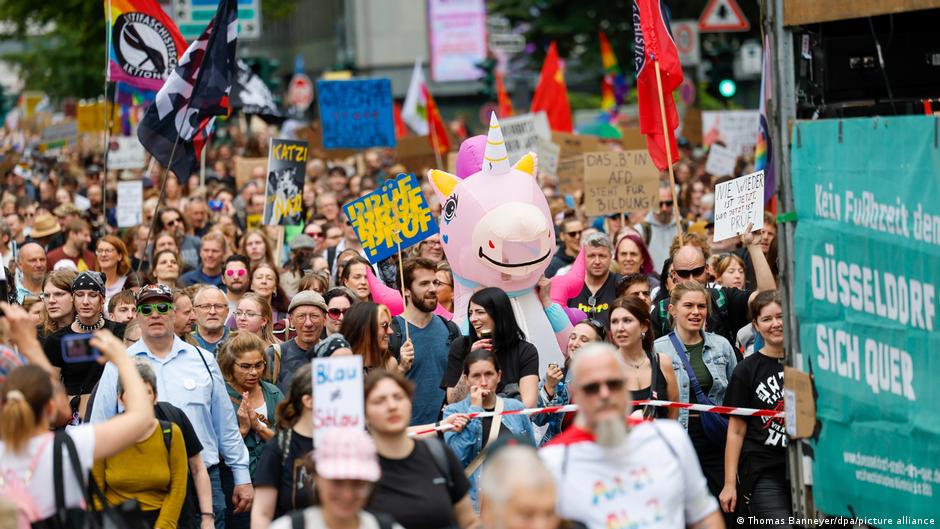
Mass demonstrations against right-wing extremism in Germany on September 12 have added a fresh political-risk signal for investors watching Europe’s largest economy. Tens of thousands of people took to the streets in more than 35 German cities, one week after the far-right Alternative for Germany, or AfD, won state elections in Saxony-Anhalt.
For capital markets, the immediate issue is not a single policy announcement or fiscal measure, but the broader investment backdrop. Political fragmentation, legal uncertainty around party classification and a widening debate over whether mainstream parties should maintain a firewall against the AfD all matter for investors assessing German equities, bonds and confidence-sensitive assets.
Organizers estimated that 25,000 people joined a demonstration in Hamburg and about 20,000 in Düsseldorf, a figure also confirmed by local police. In Berlin, police estimated turnout at 18,000. In Munich, public broadcaster ARD estimated that 12,000 people attended, while around 2,000 demonstrated in Mainz.
The protests were organized by more than 100 associations and took place across the country, underscoring the scale of civil society mobilization at a time when Germany’s domestic political balance is under renewed scrutiny. Smaller demonstrations were also reported in several state capitals and regional centers: about 1,100 people gathered in Magdeburg, the capital of Saxony-Anhalt; 1,500 in Saarbrücken; several hundred in Erfurt; and several dozen in Schwerin, capital of Mecklenburg-Western Pomerania, where the AfD was also leading in polls one week before local elections.
Political Risk Returns to the Market Conversation
Germany’s political stability has long been an important assumption for investors in European assets. The country sits at the center of the eurozone’s industrial base, sovereign bond market and policy architecture. Any sign that its party system is becoming more polarized can feed into market debates about fiscal direction, business regulation, labor policy, energy strategy and Europe-wide coordination.
The demonstrations do not by themselves point to a specific move in the DAX, Bund yields or the euro. But they sharpen investor attention on a wider question: how resilient Germany’s political center remains as the AfD gains ground. For equity investors, the key concern is whether rising political tension could affect corporate confidence, consumer sentiment or the policy predictability that international capital typically prizes. For bond investors, the focus is less on near-term credit quality and more on whether a more divided political landscape complicates future budget choices and coalition-building.
Several demonstrations, including those in Munich, Mainz, Saarbrücken and Magdeburg, were held as part of the Prüf campaign. The campaign calls for careful scrutiny of parties classified by Germany’s Federal Office for the Protection of the Constitution, or BfV, as either “suspected” of right-wing extremism or “definitely right-wing extremist.”
The campaign name translates as “check,” while organizers present Prüf as an acronym for “Prüfung Rettet Übrigens Freiheit,” meaning “checking, incidentally, saves freedom.”
That framing matters for markets because it points to the institutional dimension of Germany’s political debate. Investors tend to distinguish between electoral volatility and institutional stress. The current controversy sits between the two: it involves party competition, public protest, domestic intelligence classification and a potential legal pathway toward banning a party that has recently posted electoral gains.
AfD Ban Debate Adds Legal and Policy Uncertainty
At the demonstrations, participants called for the launch of proceedings to ban the AfD. In May 2025, the BfV classified the AfD as right-wing extremist at the federal level. However, that classification is not currently in effect because of a lawsuit filed by the party.
That legal pause is important. It means investors are looking at a political situation in which the direction of institutional action remains unresolved. A party ban procedure would be a major constitutional and political event, while failure to proceed or a drawn-out court process could leave uncertainty in place for an extended period. In either case, the issue is likely to remain visible in German politics and, by extension, in market assessments of the country’s policy outlook.
Slogans at the demonstrations reflected the confrontational tone. In Düsseldorf, protesters marched under the slogan “No step back! Against the AfD and right-wing agitation” (“Kein Schritt zurück! Gegen die AfD und rechte Hetze!”). In Hamburg, the slogan was “Time to act — freedom must be defended” (“Zeit zum Handeln — Freiheit muss verteidigt werden”).
For today’s investors, the practical takeaway is that Germany’s political risk premium may become more sensitive to polling, state elections and court developments. Large German exporters and industrial companies remain exposed primarily to global demand, trade conditions, financing costs and energy prices. Yet domestic political clarity still affects boardroom decisions, investment planning and foreign investor appetite.
The INSA opinion research institute conducted a poll on September 10 and 11 showing that 42% of respondents supported the idea of banning the AfD, while 45% opposed it. The survey also found that nearly half of Germans, 46%, opposed the “firewall” policy toward the AfD, under which other parties refuse to cooperate with it. Thirty-four percent supported maintaining the barrier, while 20% were undecided.
Those figures point to a divided electorate rather than a settled consensus. For capital markets, that division is the central signal. Investors do not need to price in immediate disruption to recognize that Germany’s political trajectory has become a more active variable. The protests show strong opposition to right-wing extremism, but the polling shows that the institutional response to the AfD remains contested.
In the near term, market participants are likely to watch whether the demonstrations affect party positioning, coalition calculations or public pressure for legal action. The broader question is whether Germany can absorb a period of heightened political conflict without weakening the predictability that has long supported its standing in European capital markets.