Ukraine Sanctions Russian Duma Vote Organizers in Occupied Regions
Kyiv’s move adds political risk around Russia-linked assets as investors weigh sanctions exposure and the durability of war-related restrictions.
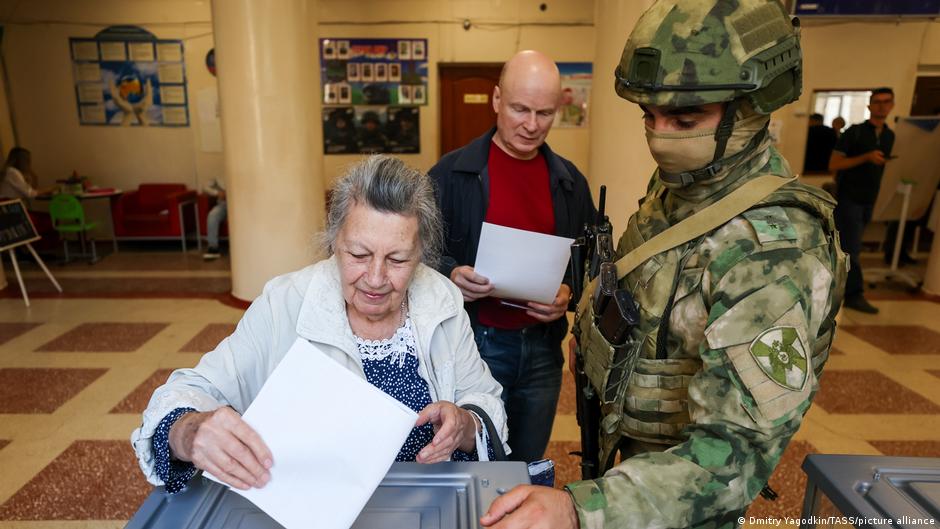
Ukrainian President Volodymyr Zelensky has imposed sanctions on people involved in organizing Russian State Duma elections in occupied Ukrainian territories, adding another layer of legal and geopolitical risk for investors tracking Russia-related exposure across equities, bonds and counterparties.
The sanctions, announced on Saturday, September 27, target 44 people linked to the conduct of the Russian parliamentary vote in areas of Ukraine under occupation. According to the Office of the President of Ukraine, 38 of those sanctioned hold both Ukrainian and Russian citizenship. Ukrainian officials said some of the individuals had previously been “elected” as so-called deputies of illegally formed local councils on temporarily occupied Ukrainian territory.
The move follows a Russian State Duma election held from September 18 to 20, during which Russian authorities for the first time organized voting in occupied areas of Ukraine’s Kherson, Zaporizhzhia, Donetsk and Luhansk regions during parliamentary elections. Ukraine and its Western allies have recognized both the process and the results as illegal.
For markets, the immediate signal is less about direct trading in the sanctioned individuals and more about the continuing expansion of sanctions architecture tied to the war. Each new designation can complicate due diligence for banks, asset managers and companies with legacy Russian exposure, especially where counterparties, local officials or entities in occupied territories may be involved.
Sanctions Risk Remains Central for Investors
The European Union has already said it is ready to impose sanctions on people who helped organize the elections in occupied Ukrainian territories. That raises the possibility of overlapping restrictions between Kyiv and Brussels, a dynamic that matters for investors because EU measures can affect market access, compliance requirements and the ability of firms to transact with designated individuals or associated entities.
Bondholders and equity investors with any indirect Russia-linked exposure face a familiar problem: the sanctions perimeter is not static. Restrictions can widen after political events, military developments or administrative acts, and those changes can influence valuations even when securities are not directly named. The announcement from Kyiv reinforces that occupied-territory governance structures remain a focus for punitive measures.
Ukraine and Western countries allied with Kyiv have recognized the voting process and its results as illegal.
That legal stance is central to the investment implications. If elections and offices created under Russian administration in occupied regions are treated as illegitimate, then officials emerging from those structures can become high-risk counterparties. Compliance teams typically respond by reviewing ownership, control, beneficial links and political exposure, particularly in sectors where Russian state influence is material.
Russian authorities created separate single-mandate constituencies for Ukrainian regions occupied after 2022 for the 2026 State Duma elections. According to the results announced by Russia, First Channel war correspondent Irina Kuksenkova and Alexander Borodai, a former “head” of the self-proclaimed republic, were declared elected in single-mandate districts in the “DNR.” In the “LNR,” Denis Kolesnikov and Ivan Sanayev, described as “deputies of the local parliament,” were announced as elected.
Russia also declared Alexey Tikhomirov elected in occupied parts of the Zaporizhzhia region and Elena Dmitruk, described as a “deputy chair of the local parliament,” in the Kherson region. All of those single-mandate candidates were nominated by United Russia, the dominant party aligned with the Kremlin.
Market Impact Is Indirect but Persistent
The latest designations are unlikely to produce a broad repricing of global equities or sovereign debt on their own. Russia’s access to Western capital markets has already been heavily restricted, and many international investors have marked down or ring-fenced Russian assets since the full-scale invasion of Ukraine in 2022. Still, incremental sanctions can matter at the margin, especially for funds managing residual positions, frozen securities, or complex exposure through subsidiaries and intermediaries.
For corporate issuers, the risk is reputational and operational as much as financial. Companies with supply chains, historical contracts or receivables connected to Russia or occupied Ukrainian territories may need to reassess whether any sanctioned individuals have a role in local administration, licensing, procurement or political oversight. Even remote connections can affect banking relationships, insurance, legal enforceability and investor perception.
The political composition of the newly announced Russian Duma representatives also has implications for how investors read the trajectory of policy. Alongside the single-mandate candidates, eight more representatives of the “authorities” in occupied Ukrainian territories entered the Russian State Duma through federal party lists. Among them is Sergey Arbuzov, a former first deputy prime minister of Ukraine under President Viktor Yanukovych and former head of the National Bank of Ukraine, who was nominated by the party A Just Russia.
From a capital markets perspective, the inclusion of figures associated with occupied territories in Russia’s federal legislature underscores the degree to which Moscow is trying to institutionalize control over those regions. For investors, that points to a prolonged sanctions environment rather than a short-term compliance episode. The more Russia embeds occupied territories into formal political and administrative structures, the more likely Western governments are to respond with additional restrictions.
The sanctions announced by Zelensky therefore sit within a broader investment theme: geopolitical risk remains embedded in Russian assets, regional debt, emerging-market risk premia and European security-sensitive sectors. Energy, banking, defense and infrastructure names can all react to shifts in sanctions expectations, even when the direct legal measures are aimed at individuals rather than listed companies.
Investors today are likely to treat the announcement as confirmation of an established trend. The war continues to generate new sanctions triggers, and elections held in occupied territories are now part of that risk map. For portfolios, the practical takeaway is clear: exposure to Russia-linked political structures remains difficult to price, difficult to exit in some cases, and vulnerable to further restrictions from Ukraine and its Western allies.