Uzbekistan ID-card fee debate highlights household strain and policy optics
A viral account of a father's struggle to pay for a first ID card has revived scrutiny of indexed state fees in Uzbekistan and their social impact.
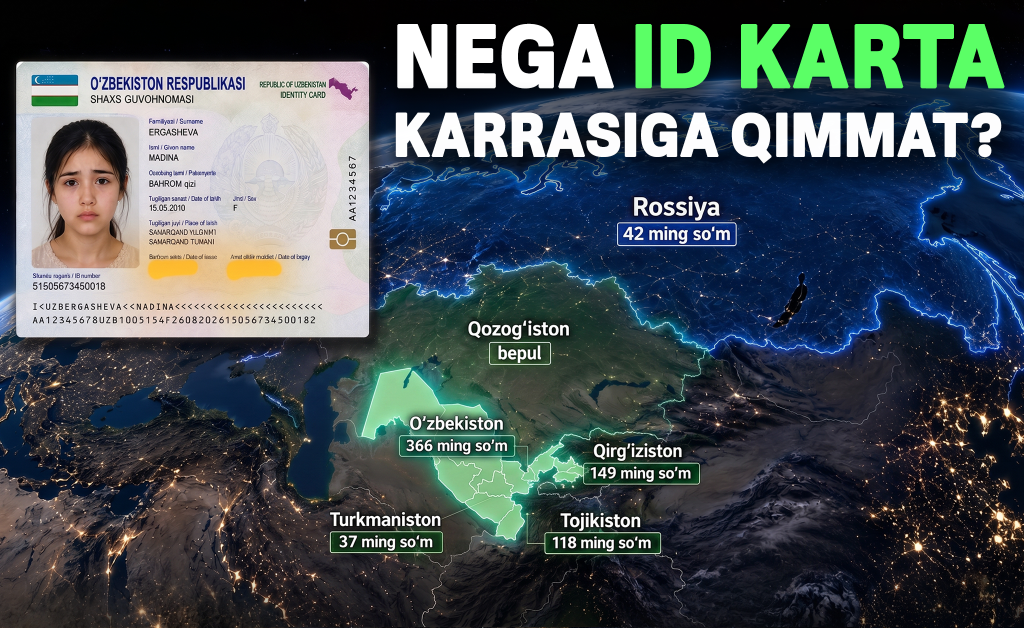
A social media dispute over the cost of obtaining a first ID card in Uzbekistan has turned into a broader debate about household affordability, state fee policy and the kind of social signals investors watch in frontier markets. Vaqt.uz examined pricing across eight countries, comparing what citizens pay for a basic identity document and highlighting how Uzbekistan stands against regional peers. For Capital Beat readers, the story is less about a single administrative charge than about what it says regarding indexed fees, consumer pressure and reform optics.
The latest wave of discussion was triggered by journalist Dilnoza Qurbonova, who described an encounter at a passport office involving a girl aged about 15 or 16 and her father, who had come to obtain her first identity document. Qurbonova wrote that she noticed the family in the queue, describing parents whose clothing and expressions reflected the strain of hard living and day-to-day worries. When the amount due at the cashier was announced, she said, the father's hands began to tremble.
He opened his wallet and began counting even his last coins one by one.
In Qurbonova's account, the daughter first looked at her father and then at the ground. The episode pushed a wider question onto the public agenda: how fair is the state duty charged for the first identity document a child receives on reaching adolescence, and how do other countries handle the same issue? For investors today, that matters because seemingly small public-service charges can become politically sensitive markers of affordability and policy calibration.
Fees tied to a rising base unit
In Uzbekistan, the state duty for receiving a first ID card depends on how the application is filed. If the request is submitted through a migration department, a public services center or a consulate, the fee is set at 89% of the base calculation amount, or BHM. With the BHM currently at 412,000 soums, that puts the charge at 366,680 soums.
If the application is filed online through my.gov.uz, the duty is lower, set at 80.1% of the BHM. That means the current cost of processing a first ID card online is 330,012 soums. The source says the BHM has been fixed at 412,000 soums since August 1, 2025, and is due to rise to 440,000 soums from September 1, 2026. As of August 31, 2026, that increase is one day away. If the fee rates remain unchanged, the state duty would rise to 391,600 soums for applications through migration offices, public service centers or consulates, and to 352,440 soums for applications through my.gov.uz. For bond investors, the point is not the scale of this single fee, but the mechanical way administrative charges move higher when the base unit increases.
Regional comparison sharpens the debate
Uzbekistan's approach stands out more clearly when placed next to neighboring and nearby states. In Kazakhstan, every citizen turning 16 has been able to receive an ID card for free from January 1, 2026, and renewal after expiry is also free. The exemption also applies to people obtaining the document for the first time after age 18, to those taking Kazakh citizenship and in some other cases. The initiative is aimed at reducing citizens' financial burden and simplifying the documentation process.
In Kyrgyzstan, citizens receiving an ID card for the first time can obtain it under the standard procedure within 12 business days for 1,103 Kyrgyz som, or about $12.6 at the current exchange rate, equal to roughly 149,000 Uzbek soums. That makes the first ID card in Kyrgyzstan about 2.5 times cheaper than Uzbekistan's current 366,680-soum duty. In Tajikistan, the fee for a citizen's ID card is set at $10, collected in somoni at the exchange rate on the day of payment. Processing takes up to 15 days. Based on the Central Bank of Uzbekistan's official rate on August 21, $10 comes to about 118,000 soums, roughly 3.1 times cheaper than in Uzbekistan.
Turkmenistan does not have a separate national ID card, and the main personal identity document is a biometric passport. According to the state migration service, the duty for issuing that passport is 60 manat. At the black-market rate cited in the source, that is about $3.2, or 37,000 Uzbek soums. Children under 16 are exempt from the payment, making the charge nearly 10 times lower than Uzbekistan's first-ID-card fee. In Russia, citizens receive an internal passport at age 14. The state duty for a first passport is 300 rubles, or about $3.6 and 42,000 Uzbek soums at the current rate, meaning it is about 8.7 times cheaper than the Uzbek charge. Under Russia's tax code, that 300-ruble duty applies both to first issuance and to regular replacement, while the fee rises to 1,500 rubles if the passport is lost or damaged.
Turkey's main identity document, the Turkiye Cumhuriyeti Kimlik Karti, is priced at 220 Turkish lira in 2026, equal to about $5 or 59,000 Uzbek soums. But if a child's birth is registered within the legally defined period and the first identity card is issued on that basis, no payment is charged. A card issued after the deadline or due to replacement costs 220 lira. In Azerbaijan, identity cards are issued from age 15, and according to the interior ministry, the state duty for standard processing within 10 days is 5 manat.
For equity investors, the direct earnings impact is likely limited, since the issue does not immediately point to a listed-company catalyst. But the debate still matters because it shows how quickly a household-level grievance can become a national policy issue. For holders of sovereign bonds or frontier-market funds, the episode offers a reminder that index-linked administrative pricing is not politically neutral. When a benchmark like the BHM rises, public reaction to resulting fee increases can shape perceptions of governance, reform durability and the social acceptability of automatic price adjustments.
The immediate story remains a fairness debate over the cost of a first identity document. Yet the timing is important. With Uzbekistan's base calculation amount set to increase on September 1, 2026, the current fee structure points to an automatic rise in the cost of a first ID card unless the rate itself is changed. That leaves investors with a familiar emerging-markets question: not whether the fee alone moves equities or bonds, but whether the policy response strengthens or weakens confidence in the broader reform narrative.