Trump Says U.S. Will Scrap 10% Tariff on Irish Whiskey Imports
The announcement in Ireland puts a narrow but visible EU spirits tariff issue back on investors’ radar as trade policy remains a market variable.
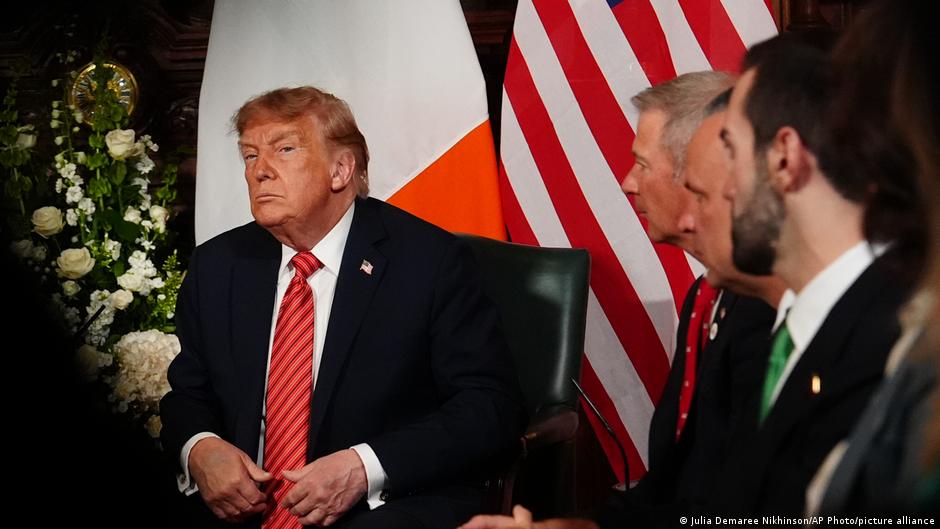
U.S. President Donald Trump said the United States will remove a 10% tariff on Irish whiskey imports, announcing the decision at the close of a visit to Ireland and placing a prominent consumer-goods trade issue back in focus for investors tracking transatlantic policy risk.
Trump made the statement on Sunday, September 13, in Ireland before a cheering crowd of Irish golf fans during a tournament held at a golf club owned by his family. According to Trump, he had agreed to numerous requests to cancel the duties on Irish whiskey imported into the United States.
The tariff currently applies as part of duties covering all exports of wine and spirits from the European Union to the United States. The president’s statement, if fully implemented, would carve out a politically and commercially visible Irish product from a broader tariff regime affecting the EU drinks sector.
Trade Signal for Consumer Goods Investors
For capital markets, the immediate significance is less about the scale of one category than about the signal. Tariffs can affect margins, pricing power, distributor behavior and demand expectations across listed consumer companies, especially in sectors where premium imported products compete for shelf space and bar placements. A reduction in U.S. import costs for Irish whiskey would be watched by investors for any effect on pricing strategy, shipment timing and sentiment toward spirits exposed to transatlantic trade policy.
The announcement also lands in a broader market environment where trade measures remain a recurring input for equities and bonds. Investors typically assess such moves through several channels: whether they reduce cost pressure for importers, whether they improve confidence for exporters, and whether they suggest a softer or more selective approach to tariff enforcement. In this case, the affected product is Irish whiskey, while the wider duties on EU wine and spirits remain the relevant backdrop.
Trump said the requests for removing the tariff came from, among others, Irish Prime Minister Micheal Martin and leading Irish golfer Shane Lowry. That detail gives the decision a distinctly Irish political and cultural framing, but markets will focus on implementation: whether the announced removal is carried out in full and how quickly importers and producers respond.
“Nothing characterizes the trade relationship between the U.S. and Ireland better than Irish whiskey,” Irish Whiskey Association director Eoin O’Cathain said in a statement.
The Irish Whiskey Association welcomed the U.S. president’s announcement. The association said it hoped the decision would be fully implemented, according to Reuters. That caveat matters for investors because tariff headlines do not always translate immediately into changed customs treatment, contract terms or earnings assumptions. Until the measure is formally executed, companies and traders may treat the statement as a potentially positive policy development rather than a completed change.
What Markets May Watch Next
Equity investors with exposure to beverage producers, distributors, hospitality operators and retailers will likely look for confirmation that the 10% duty is removed and for indications of whether savings are retained by companies, passed through to consumers or shared across the supply chain. A tariff cut can support margins if companies hold prices steady, but it can also feed promotional activity if brands use the lower import burden to defend or expand market share.
Bond investors may view the move through a broader macro lens. Tariffs can contribute to price pressures in affected categories, while their removal can marginally reduce cost friction. In this case, the measure is narrow, but it sits inside the larger question of U.S.-EU trade relations, a factor that can influence corporate credit narratives for internationally exposed issuers. Any easing of trade tension is generally easier for markets to digest than escalation, though the practical effect depends on scope and follow-through.
The setting of the announcement also added an unusual political dimension. Trump delivered the message at a family-owned golf club in Ireland before a receptive crowd, underscoring how trade policy can be presented in highly localized terms even when its consequences run through global supply chains and public markets. For investors, the key issue is not the venue but whether the policy change becomes operational.
The current levy is part of a broader framework of U.S. duties on EU wine and spirits exports. The statement therefore raises a question that markets may continue to monitor: whether Irish whiskey is a standalone exception or whether it foreshadows further adjustments affecting other European alcoholic beverage categories. The source article does not indicate any broader rollback beyond Irish whiskey.
For now, the announcement gives Irish whiskey producers and their U.S. commercial partners a potentially favorable development, while leaving investors to wait for the administrative steps needed to turn a presidential declaration into a tariff change. In market terms, the headline is constructive for the affected category, but the investable impact depends on implementation, timing and whether the removal alters revenue or margin expectations in a measurable way.