Moscow Drone Attack Puts Russian Infrastructure Risk Back in Investor Focus
Officials reported two deaths, fires and airport suspensions after a large drone attack around Moscow, sharpening market attention on security risks.
A large drone attack on Moscow and the surrounding region early Sunday placed Russian infrastructure risk back at the center of the investor conversation, after regional officials reported fatalities, injuries, fires and temporary disruption at major airports serving the capital.
Andrei Vorobyov, the governor of the Moscow region, wrote on Telegram on Sunday morning, September 20, that two people had been killed and at least six injured in what he described as a massive drone attack. He said 249 Ukrainian unmanned aerial vehicles had been shot down over the region.
For investors tracking Russia-linked assets, energy flows and geopolitical risk premiums, the reported scale of the incident matters as much as the immediate damage. Moscow is not only Russia’s political center but also a transport, logistics and financial hub. Attacks that disrupt residential districts, industrial sites, logistics facilities or airports can quickly feed into assumptions about insurance costs, operational continuity and the vulnerability of critical infrastructure.
Energy and Logistics Exposure
Vorobyov said a warehouse complex caught fire in Sofyino after the attack. The anonymous Telegram channel VChK-OGPU claimed that a logistics complex of about 850,000 square meters there was completely engulfed in flames. That claim could not be independently verified from the source material, but it points to the type of infrastructure investors often watch closely: warehouses, freight nodes and distribution facilities that support supply chains around a major urban economy.
The governor also said drones struck and caused fires in three apartment buildings and one private house. Such reports broaden the incident beyond a purely military or industrial frame, raising the potential political and economic cost of air-defense pressures around the capital region.
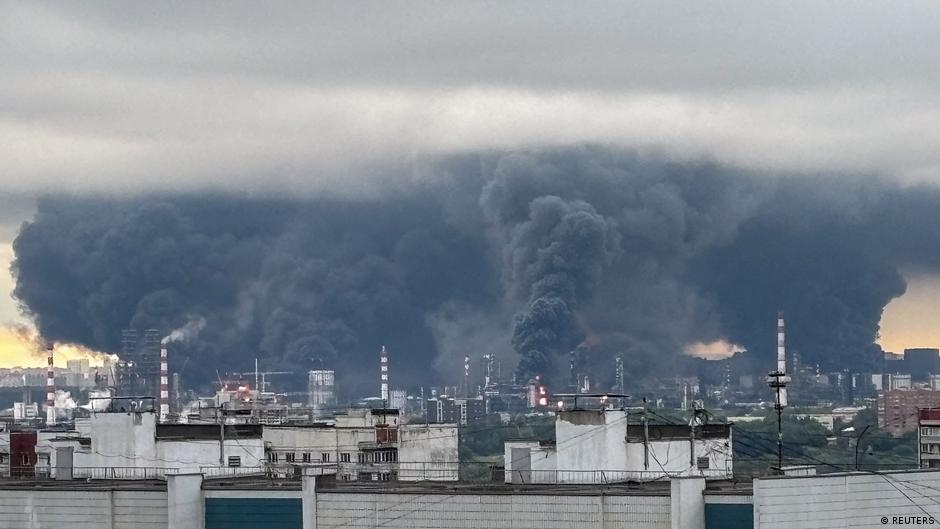
Moscow Mayor Sergei Sobyanin said 186 drones had been downed on approach to Moscow. He also reported damage to a facility on the territory of the Moscow oil refinery, adding that there were no casualties there.
“A facility on the territory of the Moscow oil refinery was damaged. There were no casualties,” Sobyanin said, according to the source article.
According to VChK-OGPU, the refinery in Moscow’s Kapotnya district was on fire. The same source article noted that the refinery had already come under attack in June. For capital markets, repeated incidents involving refining infrastructure tend to sharpen attention on fuel supply resilience, repair costs and the risk that energy assets may require greater protective spending.
The source article also said that, according to VChK-OGPU, drones attacked a thermal power plant in Lyubertsy and that a UAV struck a residential building in Kotelniki. The Telegram channel Ostorozhno, Novosti, citing local residents, reported a fire in a residential complex in Kotelniki. In Istra, debris from a drone damaged an apartment in a residential building, according to municipal district head Tatyana Vitusheva.
Airport Disruption and Market Signals
Operations were suspended at three Moscow-area airports: Vnukovo, Domodedovo and Zhukovsky. Even temporary pauses at major aviation hubs can matter for investors because they show how security incidents can spread from direct physical damage into broader transport and services disruption. Airspace restrictions, delays and airport closures may carry costs for airlines, logistics operators, travelers and connected businesses.
The immediate market implications will depend on how Russian authorities, companies and counterparties assess the damage, the duration of disruption and the perceived likelihood of further attacks. The source article did not report equity, bond, currency or commodity price moves. Still, events of this kind typically enter market analysis through several channels: sovereign risk perceptions, energy infrastructure risk, local corporate continuity, and the broader geopolitical risk premium applied to exposed assets.
For bond investors, the significance lies less in any single facility and more in the accumulation of security costs and operational uncertainty. Repeated attacks near the capital can reinforce concerns over fiscal burdens, infrastructure repair needs and the resources required for air defense. For equity investors, the focus turns to sectors with physical exposure: energy, transport, logistics, utilities and property.
Energy markets may also pay attention to reports concerning the Moscow oil refinery, though the source article did not provide details on production impact, outage duration or repair requirements. Without those details, investors are likely to treat the refinery report as a risk marker rather than a quantified supply event. The same applies to the alleged fire at the large logistics complex in Sofyino, where the source article provided the Telegram channel’s claim about the scale of the facility but did not offer confirmed financial or operational losses.
The reported casualties and residential damage add a separate layer to the market reading. Civilian harm tends to raise the domestic salience of security incidents and may affect expectations for policy responses. Investors will be watching whether the attack leads to new restrictions, emergency spending, insurance adjustments or changes in transport operations around Moscow.
For now, the key takeaway for capital markets is that infrastructure risk around Russia’s largest metropolitan area remains active and capable of touching multiple asset classes. The incident combines human casualties, reported industrial damage, logistics disruption and airport suspensions in a single episode. That mix is likely to keep investors focused on resilience, exposure mapping and the possibility that geopolitical risk premiums remain elevated.